Who is Kobayende? History, attributes, and signature in Palo Mayombe

Kobayende is an mpungo of the Mayombe stick related to illness, suffering, death, and the possibility of healing. It also appears as Cobayende, Coballende, Kubayende o Foot in Wound, among other variants preserved by different houses.
Her figure occupies the boundary between two states: the body that falls ill and the one that recovers strength, life that weakens and death that approaches. For this reason, she is respected as a force capable of accompanying healing, but also as a presence that reminds us of human fragility and the consequences of neglecting our health.
Basic information sheet for Kobayende
| Appearance | Description |
|---|---|
| Main name. | Kobayende. |
| Writing variants. | Cobayende, Coballende, Kubayende and Kowayende. |
| Other documented names. | Pata en Llaga, Pata Llaga, Pata Puri, Tata Pansua, Mpungu Fútila, and Tata Kañengue, among others. Not all houses use them in the same way. |
| Religious tradition. | Palo Mayombe, Palo Monte and Reglas Congas. |
| Classification. | Mpungo or great spiritual power. |
| Main domains. | Disease, epidemics, bodily suffering, transformation, death, health protection and healing. |
| Associated numbers. | The 7 and the 17. |
| Most widespread color. | Purple or violet. In specific treatises, red, white, black, and burlap also appear, depending on the ritual function. |
| Popular date. | December 17th, due to the Cuban association with Saint Lazarus. It should not be presented as an African-origin date nor as a mandatory celebration in every Palo house. |
| Visual attributes. | Sores, walking sticks or crutches, dogs, burlap, grains, roasted corn, lamps, and healing elements. Many of these come from Cuban syncretism. |
Who is Kobayende in Palo Mayombe?
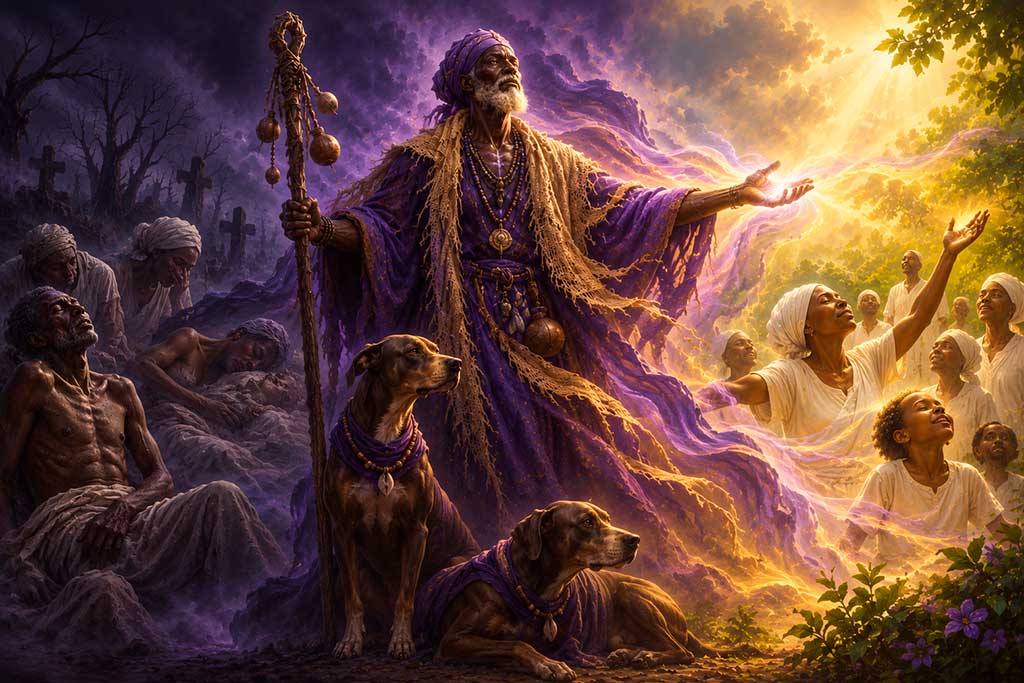
Kobayende is one of the great spiritual forces included among the mpungos of Palo MayombeIts domain relates to that which alters or threatens the body: diseases, epidemics, injuries, physical deterioration, and processes that place a person in front of their own limits.
At the same time, it is attributed with the ability to contain harm, accompany the sick, and promote recovery. This dual dimension explains why it is both respected and feared. It is not only "the one who makes sick" nor only "the one who heals"; it represents the power that exists on both sides of the experience.
Contemporary ethnography describes him as the mpungo of illness and health, capable of transmitting a particularly healing guidance to a nganga. Other sources link him to serious illnesses, infections, and the passage of the dead. Each house organizes these attributes according to its own traditions.
Speaking of Kobayende as the lord of disease does not mean that every illness is a spiritual punishment. Illnesses have biological, environmental, social, and psychological causes that require professional attention. Religious interpretation can offer support, but it does not replace medical diagnosis or treatment.
Origin of the name and variants
The oldest and most stable form in part of Cuban bibliography is CoballendeCobayende, Kubayende, Kobayende, and Kowayende are also found. The differences reflect oral transmission and attempts to represent sounds from the ritual language in Spanish.
Lydia Cabrera registered Coballende and the names Pata Llaga or Pata Puri within the Reglas Congas. The modern English edition of El Monte He explains that Coballende can be transliterated as Cobayende, while other communities prefer the form Kobayende.
The following also appear in academic and practitioner sources:
- Pata en Llaga, Pata Llaga or Pata Puri.
- Tata Pansua.
- Mpungu Fútila or Pungun Futila.
- Tata Kañengue or Tata Kañeñe.
- Matalá and Patipolo.
- Tata Nfumbe, Tata Fumbe or Tata Funde.
It is not correct to claim that all these names are perfect synonyms. Depending on the house, they may function as titles, regional designations, names of foundations, or forms linked to other Afro-Cuban traditions.
Some specific treatises link Kobayende to Kavungo, Kaviungo, or Kafungê, names found in other religious expressions of Central African origin. However, the exact historical and linguistic relationship is not sufficiently demonstrated to present it as a universal equivalence.
History of Kobayende in Cuba
No single historical record exists that allows us to trace an African deity named Kobayende from a specific territory to Cuba. What the sources show is an Afro-Cuban formation process that combined Kongo elements, Central African memories, Arará and Yoruba influences, and the Catholic devotion to Saint Lazarus.
The Congo Rules developed in Cuba within cabildos (religious societies), religious families, and autonomous houses. In that environment, the names and functions of the powers were adapted to new languages, epidemics, landscapes, and relationships with other religions.
Coballende already appears in Lydia Cabrera's ethnographic records as a force of the Congo Rules related to sores, leprosy, and healing. Cabrera notes that Pata Llaga or Pata Puri could be invoked through a Coballende nganga and that, in certain manifestations, the one who received the spirit wielded a caguairán wood staff.
During the 20th century, the image of Kobayende became increasingly similar to Babalú Ayé and to Saint Lazarus beggar of Cuban devotion. This convergence did not completely erase religious differences, but it did produce a shared iconography: sores, dogs, crutches, burlap, pimples, and promises for health.
The December 17th celebration is primarily part of this Cuban process of convergence. Practitioners of Paleros, Santeros, Spiritists, and Catholic devotees can all participate on the same date, even though they understand the venerated figure from different traditions.
Stories and mythology about Kobayende
There is no uniform mythological corpus comparable to a single collection of patakís. The known accounts come from different houses and treatises. They should be presented as lineage versions, not as an official history.
The story of loyalty to Nsambi
A treatise on Palo Cruzado and Briyumba published at the end of the 20th century recounts that Kariempeve tried to separate Kobayende from Nsambi. When he failed, he sent him a leprosy-like illness, causing people to reject him.
According to this account, Kobayende chose to uphold his oath rather than accept healing in exchange for renouncing Nsambi. After enduring illness and rejection, Nsambi restored his health and granted him knowledge of diseases and blood.
The narrative also explains why, within that lineage, ordinary water is avoided in certain rituals: during his illness, people threw water at Kobayende to drive him away. The sacred object is then associated with coconut water and dry wine.
This story contains very visible Christian categories—God, the Devil, temptation, and fidelity—and connections to Dahomey, Ocha, and Ifá. Therefore, it should be read as an Afro-Cuban and Palo Cruzado creation, not as an ancient Kongo myth preserved unchanged.
The man who returned from the dead
Another tradition, ethnographically documented by Todd Ramón Ochoa, presents Coballende as the only human being who returned to life. This experience makes him a mediator between the living and the dead.
In this version, he may appear as the driver of a funeral cart, responsible for transporting the deceased. This image helps explain why some families associate him not only with illness but also with the passage to the underworld.
The difference between the two accounts shows how the tradition works: one emphasizes fidelity and control over illness; the other, death, return, and mediation. Neither version alone fully captures the meaning of Kobayende.
The meaning of Pata en Llaga
Foot in Wound o Sore Leg It alludes to the wounds on the legs and the body marked by suffering. The name encapsulates the image of a power that understands illness from within, not from a distant perspective.
In the Cuban imagination, this figure is often depicted as an old man who walks with difficulty, trembling with pain and leaning on a cane or crutches. Dogs may accompany him and lick his wounds.
Much of this representation comes from the image of Saint Lazarus the beggar and Babalú Ayé. It should not be presented as an exclusively Congolese iconography nor as an identical description in all Palo houses.
Kobayende, the disease and the healing

Illness is its most constant domain. It is associated with epidemics, infections, skin conditions, sores, prolonged illnesses, and states of deterioration that transform the life of the person and their family.
Its connection to healing is understood as the other side of that power. Those who understand illness can also contain it, remove its influence, guide recovery, or strengthen someone undergoing treatment.
Within religious language, Kobayende can represent:
- The fragility of the body.
- The collective spread of an epidemic.
- The isolation and rejection of the sick person.
- Resistance during prolonged illness.
- The transformation after a crisis.
- Recovery and return to everyday life.
- Accepting the end when a cure is no longer possible.
Spiritual care can complement medicine, but never replace it. It is irresponsible to attribute all illnesses to a lack of religious faith, promise guaranteed cures, or recommend discontinuing treatment.
Kobayende and the world of the dead
Some sources call him "king of the dead" or present him as one of the powers closest to the cemetery. Others describe him as a cart driver, mediator, or conductor of the deceased to the realm of death.
These expressions should not become a universal hierarchy. The Conga Rules also relate to Sparkle NdokiKalunga and various ngangas with cemeteries, the dead, and spiritual transit.
In certain lineages, Kobayende is especially concerned with those who died after serious illnesses or prolonged suffering. In others, its relationship with the dead appears integrated into its foundation without establishing a separate category.
The most accurate way to understand it is as a power situated near the boundary between illness, deterioration, death, and recovery. The extent of that relationship depends on the specific treaty of each house.
Numbers, colors, and attributes of Kobayende
Information circulating online often conflates Palo, Ocha, Arará tradition, and devotion to Saint Lazarus. The following table distinguishes the most frequently mentioned associations and their level of caution.
| Feature | Widespread association | How should it be interpreted |
|---|---|---|
| Number 7. | It appears repeatedly in treatises: seven grains, candles, reinforcements, kingdoms, or ceremonial elements. | It's a strong association in certain houses, but not a mandatory figure for every foundation. |
| Number 17. | It is related to the date of Saint Lazarus, beads, coins, grains and other elements in Palo Cruzado sources and in Cuban devotion. | His presence is deeply marked by syncretism with Babalú Ayé and San Lázaro. |
| Purple or violet color. | It is the most widespread color in modern publications and in Cuban iconography of San Lázaro. | It can be used as a visual reference, but it should not be presented as the sole ritual color of Kobayende. |
| Red, white and black. | They appear in accounts, fabrics, and components described by particular treatises. | Its use depends on the function, the foundation, and the lineage. |
| Burlap. | It is related to poverty, illness, penance, and the iconography of Saint Lazarus. | It is a widespread Cuban association, shared with Ocha and popular devotion. |
| Crutches or cane. | They express difficulty walking, pain, and need for support during their illness. | The iconography is shared with Babalú Ayé and San Lázaro. |
| Dogs. | They accompany the sick person and appear as helpers or symbols of care. | They come mainly from the imagery of Saint Lazarus and related Afro-Cuban stories. |
| Grains and toasted corn. | Some houses symbolically link them to illness, cleansing, and transformation. | They are a repeated ritual association, but the types, quantities, and uses are reserved. |
| Lamps, candles and incense. | They are related to attention in dark spaces, purification, and communication. | Specific uses vary from house to house and do not constitute a public recipe. |
| Dry wine and coconut water. | A treatise on lineage uses them instead of ordinary water. | It is a particular practice linked to a ritual narrative; it should not be generalized. |
| Date: December 17th. | Central day of Cuban devotion to Saint Lazarus and Babalú Ayé. | It may be observed by syncretic houses, but it is not a universal date nor exclusively a palera one. |
How is Kobayende being cared for?
Devotion to Kobayende is characterized by sobriety, respect, and constancy. Because he is associated with illness, pain, and recovery, he is not treated as a force for fleeting matters, nor are requests made to him out of mere curiosity.
In general, their care may include:
- A clean and quiet space. Its foundation is usually kept in a sober place, away from noise and attended to with reverence.
- Lights or lamps. They are used as a symbol of clarity, protection, and support during illness processes.
- Ritual smoke. In some homes, tobacco or incense is used to greet, cleanse the environment, and accompany the singing.
- Grains and toasted corn. They frequently appear among the elements associated with Kobayende, especially because of their symbolic relationship with diseases, cleansing, and transformation.
- Dry wine and coconut water. Some lineages employ them among their customs, although their use depends on the treaties of each house.
- Burlap fabric and purple tones. They are related to suffering, humility, and the Cuban iconography developed around Pata en Llaga.
- Songs and mambos. They serve to greet, call, and acknowledge their presence within the foundation.
- Periodic consultation. Care is not decided solely by habit; consultation allows us to know what the foundation requires at a given moment.
- Continuity. Kobayende is not only addressed when illness arises. The relationship demands respect and constant commitment.
The elements and the way they are presented vary depending on the munanso. Practices of Palo, Ocha, and popular devotion to Saint Lazarus should not be mixed indiscriminately, even though they share some symbols.
When the request is related to an illness, spiritual care can offer strength and support, but it should be done in conjunction with the corresponding medical evaluation and treatment.
The foundation of Kobayende
In homes that recognize her power, Kobayende may be present in a nganga or prenda Born according to genealogy and the treatises of the munanso. The presence of the mpungo is not demonstrated by the appearance of the vessel nor by gathering objects associated with the disease.
Some sources describe foundations oriented toward protecting the sick, the body's resilience, healing, and proximity to death. Others place greater emphasis on epidemics, prolonged illnesses, or the capacity to accompany processes of transformation. These differences reflect the autonomy of the homes, not necessarily a contradiction.
Names of sacred objects, accompanying Luceros (spiritual guides), and specific designations related to Kobayende may also appear. One published treatise mentions, for example, Lucero Katilembe or Lucero Pata Llaga. This information belongs to a lineage context and does not imply that every nganga (sacred object) of Kobayende must have a companion with that name.
From an educational perspective, the essential point is to understand that the foundation embodies a religious history: it originates from another garment, belongs to a specific house, and is tied to particular obligations. It cannot be explained by a recipe nor legitimized by a photograph.
Kobayende's main firm
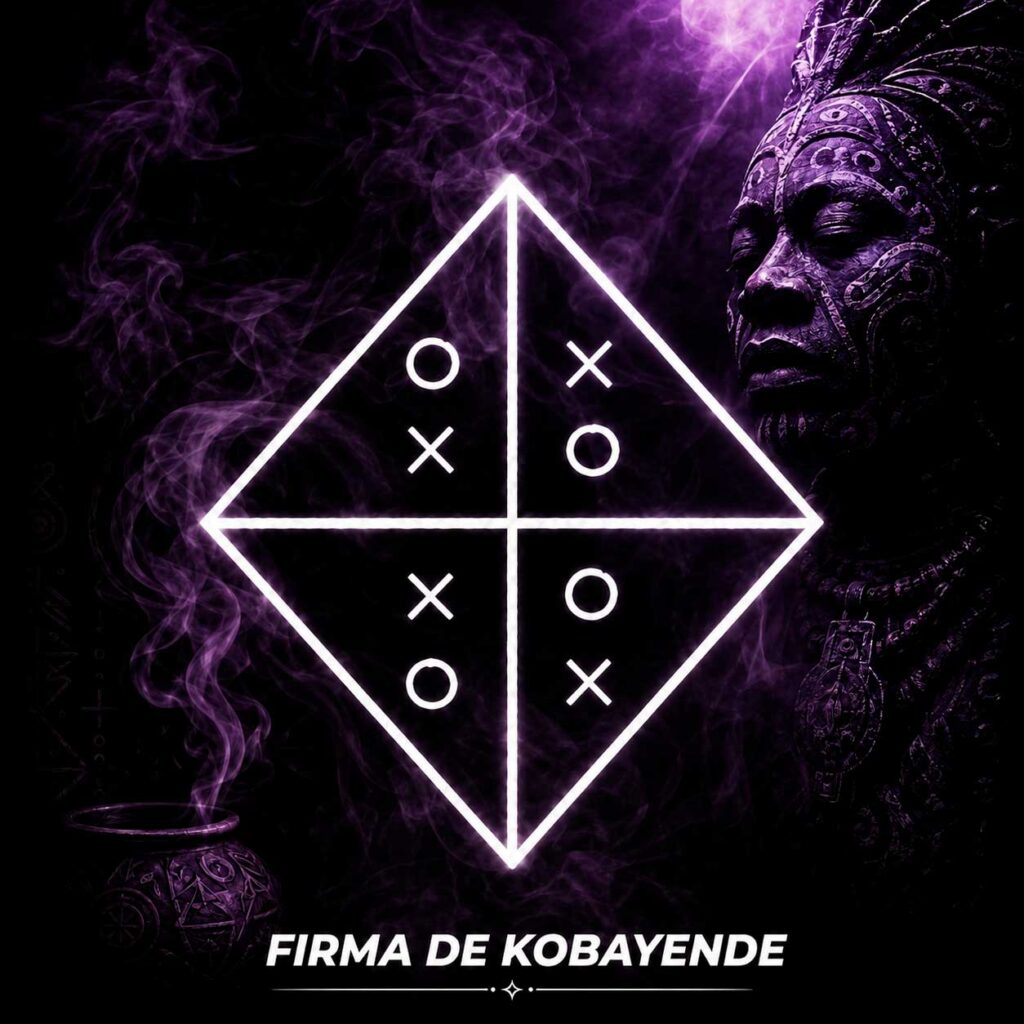
signatures or patipembas They identify forces, foundations, houses, and ritual functions. That is why there is no single signature of Kobayende that can... The signature of Kobayende
Kobayende's signature is represented by a rhombus divided by a vertical and a horizontal line, forming four spaces around a central point. Within these spaces are distributed circles and crosses that reinforce the balance of the design.
The outer rhombus concentrates and defines the symbol's power. The central cross marks the four directions and unites the different planes on a single axis. The circles represent points of power and presence, while the crosses signify authority, protection, and dominion over the forces related to illness, death, and healing.
As with other Palo Mayombe signatures, its design may vary depending on the house, the foundation, and the work for which it is used.
Kobayende, Babalú Ayé and San Lázaro
Cuban religious coexistence brought Kobayende closer, Babalu Aye and Saint Lazarus. The three became associated with illness, sores, suffering, protection, and hope of healing.
| Name | Tradition or context | Main distinction |
|---|---|---|
| Kobayende or Pata en Llaga. | Palo Mayombe and Reglas Congas. | Mpungo attended according to foundations, signatures and paleros treaties. |
| Babalú Ayé. | Rule of Ocha and other related Afro-Cuban traditions. | Orisha with stories, ceremonies and foundations of Ocha and Arará influences. |
| Saint Lazarus. | Catholicism and Cuban popular devotion. | Christian figure venerated through promises, pilgrimages and prayers. |
In popular practice, boundaries can become blurred. The same person may participate in Palo, Ocha, spiritism, and Catholic devotion. This explains why on December 17th, the color purple, crutches, dogs, and burlap appear in more than one record.
What is being asked of Kobayende?
The requests are usually related to health, protection, and the ability to overcome difficult situations. Depending on the house, one might ask for:
- Protection against epidemics and contagious diseases.
- Strength during treatment.
- Recovery and stability.
- Relief for a person who is suffering.
- Clarity in making health decisions.
- Emotional support for the patient and their family.
- Support during a prolonged process.
- Serenity when recovery is not possible.
These requests fall within the realm of faith. They do not replace examinations, medications, medical interventions, or emergency care.
Frequently Asked Questions about Kobayende
Who is Kobayende in Palo Mayombe?
It is an mpungo related to illness, epidemics, death, and healing. The ways of understanding and dealing with it depend on each branch and lineage.
Are Kobayende and Pata en Llaga the same thing?
Pata en Llaga or Pata Llaga is one of its most common names. In some households it may function as a general name, and in others it may take on a more specific meaning.
How else is Kobayende spelled?
It also appears as Cobayende, Coballende, Kubayende, and Kowayende. The variants reflect oral transmission and different ways of writing the ritual language.
What is the color of Kobayende?
Purple is the most widespread color. However, some treatises also use red, white, black, and burlap. There is no single color palette that works for all fundamentals.
Is Kobayende Babalú Ayé?
They are not identical. They were associated in Cuba because they share links to illness and healing. Babalú Ayé belongs to the Regla de Ocha (San Martín tradition) and Kobayende to the Reglas Congas (Conga tradition).
Is Kobayende Saint Lazarus?
Not in the strict sense. Saint Lazarus belongs to Christianity and to popular devotion. The historical association explains why they share images, dates, and symbols in Cuba.
Sources and editorial criteria
The public reconstruction of Kobayende requires distinguishing between ethnography, oral tradition, lineage treatises, and popular content. For this article, the following have been considered:
- Lydia Cabrera, El Monte and his records on Coballende, Pata Llaga and Pata Puri.
- Todd Ramón Ochoa, Society of the Dead, especially his references to Coballende as a mediator between life and death.
- Katerina Kerestetzi, studies on the nganga and the influence of the mpungo on the character of the foundation.
- Arturo West-Durán, study on the work of José Bedia and the shared iconography of Coballende, Babalú Ayé and San Lázaro.
- Jesús Fuentes Guerra and Armin Schwegler, research on the language and rites of Palo Monte Mayombe.
- A treatise of Kowayende attributed to Eduardo Miguel Perea, dated 1998, used only as testimony of a Palo Cruzado lineage and not as a universal norm.
- A contemporary sheet of basic signatures associated with different mpungos, used only as an iconographic reference to select the representative signature of the article.
The specific claims are presented as such. This content is historical and informative: it does not reproduce complete ceremonies, does not offer fundamental recipes, and does not replace the teachings of a Tata, a Yaya, or an authorized elder.
This article is part of our guide on the mpungos of Palo Mayombe and from the section dedicated to Palo Mayombe and the Conga Rules.
Other mpungos and foundations of Palo Mayombe
Kobayende is part of a larger group of forces related to nature, the dead, and the foundations of each house. Explore the following content to learn about other mpungos and understand how they relate to the nganga, the nfumbe, and the organization of the Reglas Congas.