What is a Tata Nganga? Functions and authority in Palo Mayombe
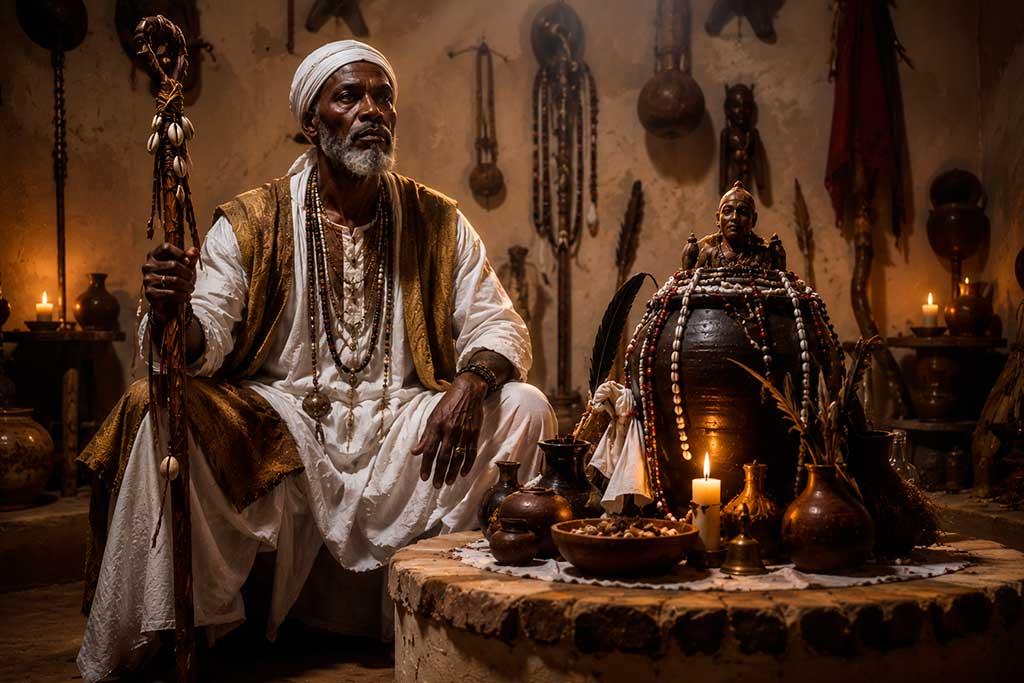
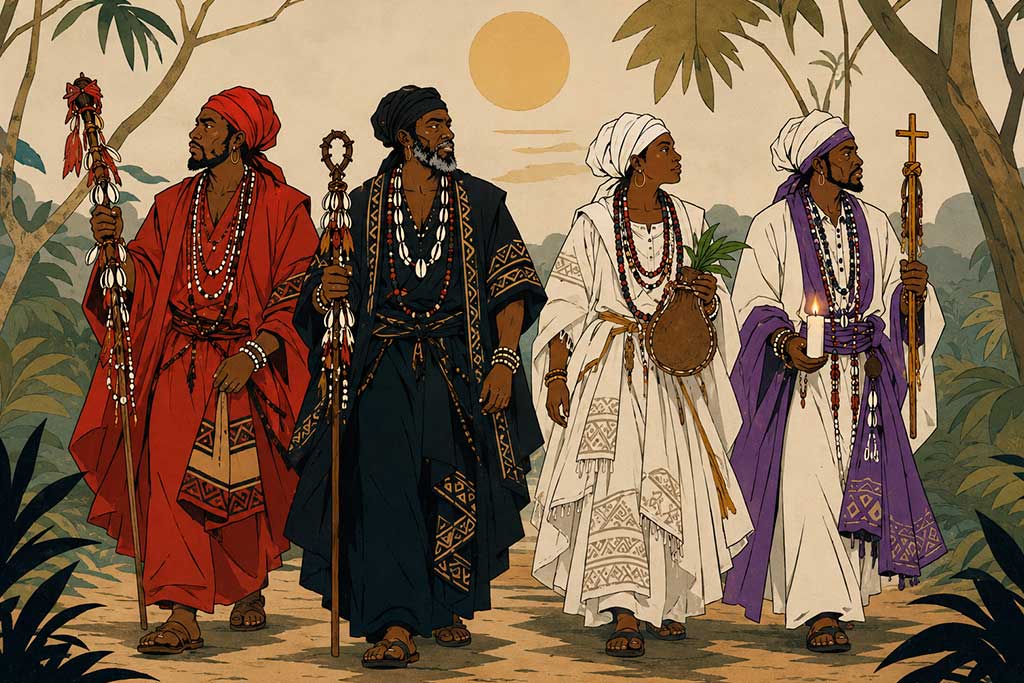
Un Tata Nganga is a male religious authority within the Mayombe stick and other branches of the Conga Rules. He holds a recognized position within his lineage, attends to fundamental principles, transmits knowledge, and can assume responsibilities for initiates and ceremonies according to the faculties he has received.
The title does not necessarily mean that one is the sole head of a house, nor that all Tatas possess exactly the same authority. A munanso may include several Tatas and Yayis, with one of them serving as the principal authority. Their roles depend on the lineage, the consecrations received, and the authorization of the elders.
To understand what a Tata Nganga represents, it is also necessary to distinguish him from the Ngueyo, the Father or Mother Nganga, the Yaya Nganga, and positions such as Bakofula. These designations are part of a flexible organization that varies between houses and lineages.
Basic information sheet of the Tata Nganga
| Appearance | Description |
|---|---|
| Main name. | Tata Nganga. |
| General meaning. | Male religious authority of the Conga Rules with initiations, knowledge and responsibilities recognized by his lineage. |
| Religious tradition. | Palo Mayombe, Palo Monte and other branches of Regla Conga. |
| More widespread female equivalent. | Yaya Nganga or Yayi Nganga. Ngudi Nganga, Mama Nganga and other names also appear depending on the house. |
| Relationship with the nganga. | Possesses access and responsibility for fundamentals according to the degree and powers received. |
| Relationship with the initiates. | He can teach, guide, and religiously vouch for godchildren, depending on his position within the munanso. |
| Typical functions. | Attention to fundamentals, teaching, consultation, ceremonial direction, preservation of lineage and organization of the house. |
| How to obtain the degree. | Through initiation, recognition, and authorization within a religious genealogy; not by self-proclamation. |
| Variations. | Titles, ranks, and roles vary between Mayombe, Briyumba, Kimbisa, Palo Monte, and the different houses. |
Important: “Tata Nganga” does not function as an identical administrative title throughout the religion. Its scope can only be understood within the house and lineage that recognizes it.
What is a Tata Nganga?
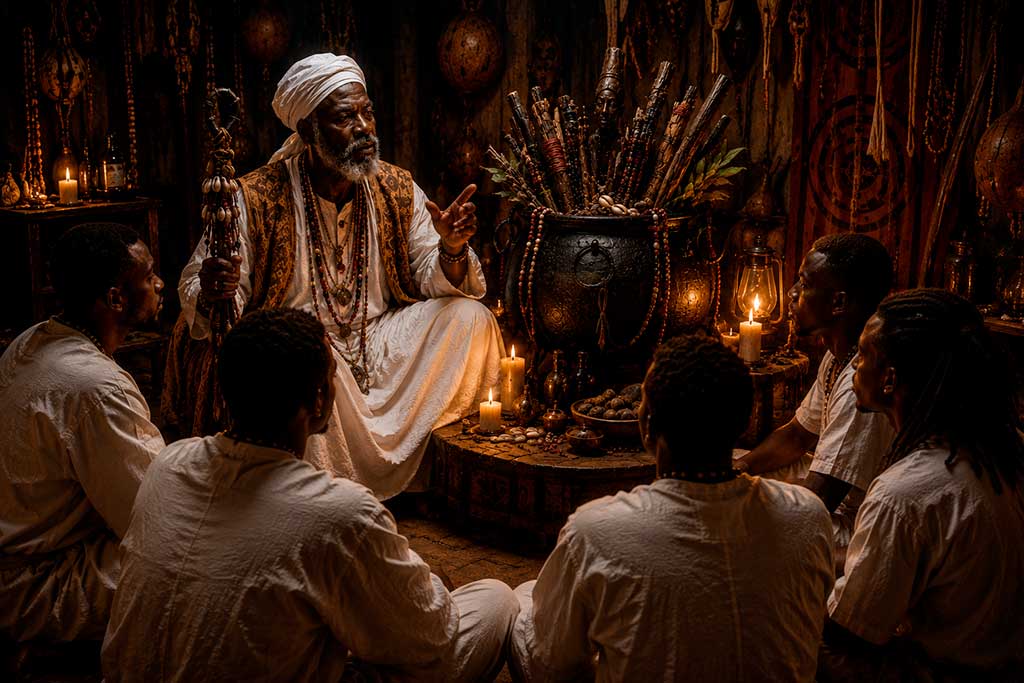
The Tata Nganga is a high-ranking initiate within a Palo religious family. In ethnographically documented houses, the Tatas and Yayis appear as the principal teachers, authorities, and arbiters of the direction of the munanso, religiously subordinate to the foundations they serve.
This does not mean that each Tata is the absolute owner of a house. There can be several Tatas and Yayis within the same munanso, with differences in seniority, prestige, and responsibility. The person who heads the house is usually recognized as godfather, godmother, or principal authority, but their position is sustained through lineage and the religious community.
Being a Tata involves more than knowing prayers or possessing objects. Authority rests on a combination of elements:
- Initiation. He has received ceremonies that place him in a recognized category within his house.
- Lineage. His authority comes from earlier and more fundamental principles, not from a personal declaration.
- Knowledge. He knows songs, signatures, consultations, forest subjects and rules transmitted by his branch.
- Responsibility. He is responsible for religious decisions and for the people who come under his guidance.
- Faculties. You may only perform the functions for which you have been trained and authorized.
- Recognition. His rank must be accepted by his house and by the elders who support his genealogy.
Age or years within the religion can influence prestige, but they are not the sole determining factor. There are lineages where consecration is received after prolonged training, and others where a person attains a high rank at a young age due to their genealogical background.
What do the words Tata and Nganga mean?
Tata It is a widely used word in Bantu languages to express father, elder, or figure of respect. Within Palo, it is used as a religious title and as a way to acknowledge authority.
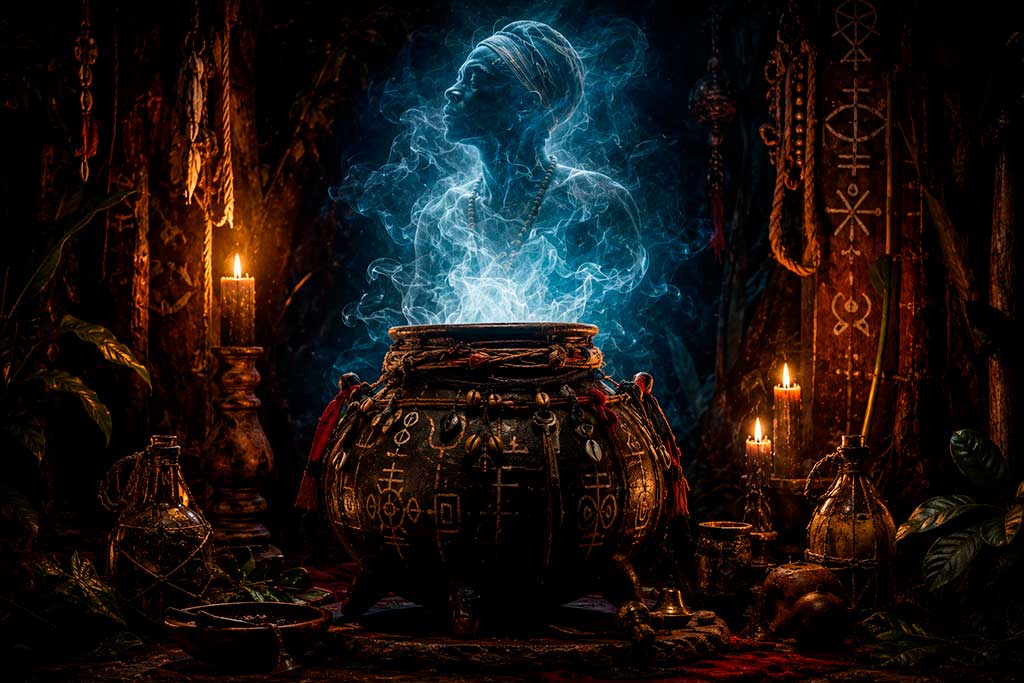
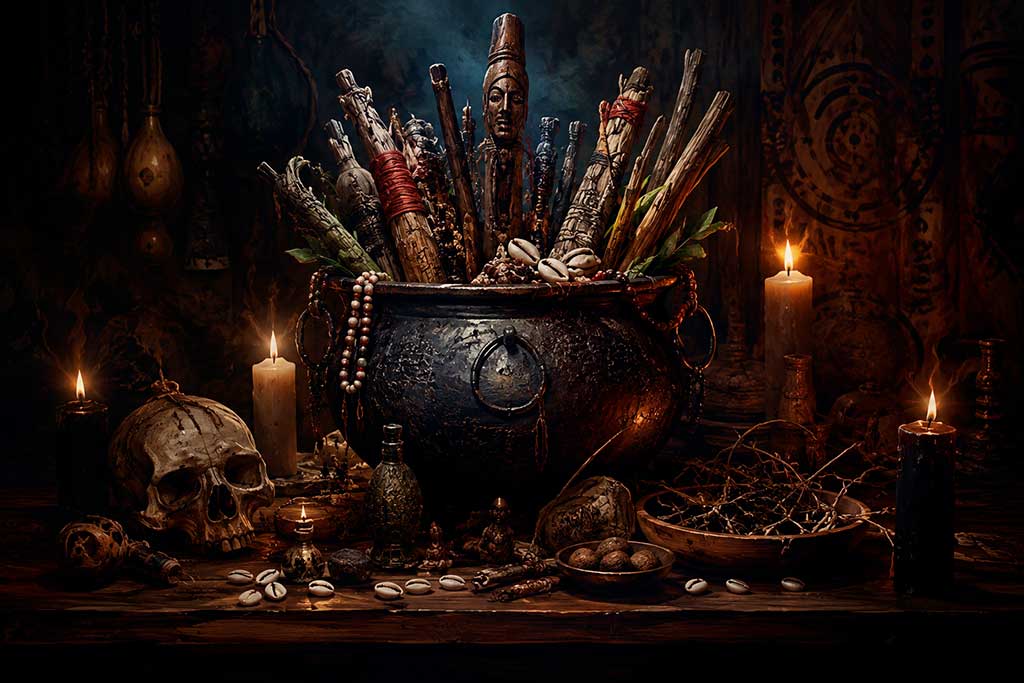
Nganga It has a more complex history. In various Central African societies, it was associated with ritual specialists, healers, diviners, and those knowledgeable in medicines or consecrated forces. In Cuba, the word also came to designate the nganga or prenda, the material and spiritual foundation located at the center of the palera practice.
The title Tata Nganga encompasses these two dimensions: the religious elder and his connection to the knowledge and foundations of the house. It should not be translated simply as "owner of a cauldron," because authority does not derive from possessing a vessel, but from a lineage and the responsibilities one has acquired.
Functions of a Tata Nganga
The exact roles vary between houses. A Tata may be the main authority of the munanso, be part of the group of elders, or carry out specific responsibilities under the direction of another Tata or a Yaya.
Among its most common functions are:
- Address the fundamentals. He maintains the religious obligations related to the garments to which he has access and authority.
- Direct inquiries. He interprets divination systems and guides decisions that correspond to his rank.
- To teach the initiates. It transmits knowledge gradually, according to the level, behavior, and preparation of each member.
- Preserving genealogy. It preserves names, songs, signatures, rules, and stories received from its elders.
- Organize ceremonies. Coordinates or participates in the acts for which he/she has authorization.
- To be responsible for their godchildren. It guides their religious development and corrects breaches or errors within the home.
- Mediating in conflicts. He intervenes when disagreements arise that affect the life of the munanso.
- Represent the house. He can relate to other elders and munansos on behalf of his religious family.
The responsibility for a godchild does not end with initiation. The bond between godparent and godchild is built through teaching, presence, and mutual obligations. When that relationship breaks down, the problem is not only personal: it can affect the initiate's religious continuity.
Differences between Tata, Tata Nganga, Tata Nkisi and palero
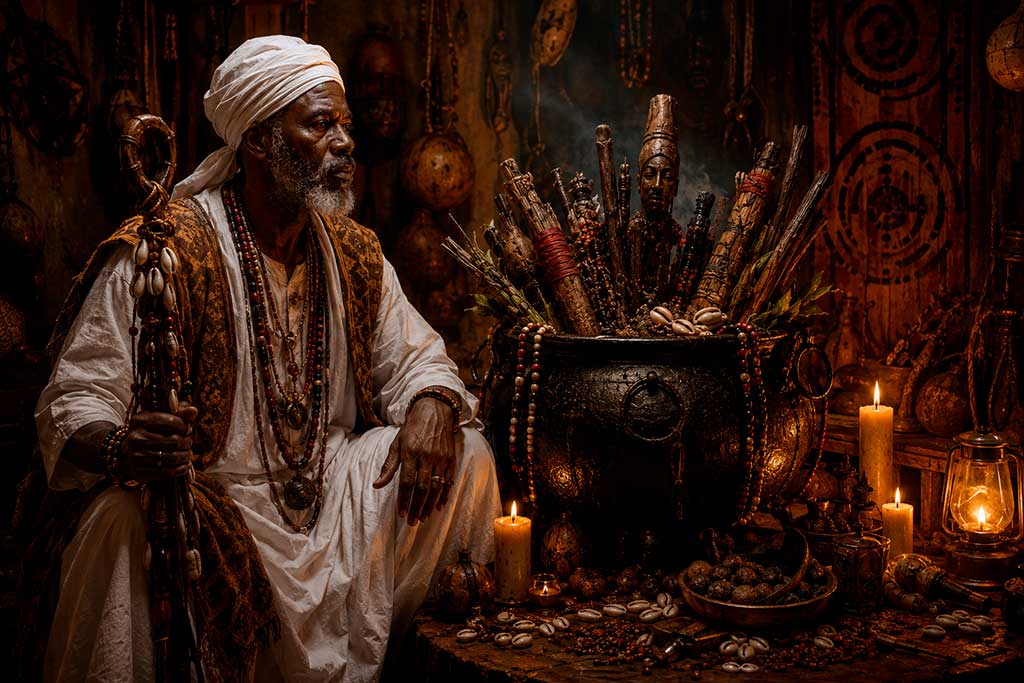
These names do not have the same definition across all lineages. The following table lists common uses without establishing a universal scale.
| Term | General use |
|---|---|
| Palero or palera. | Broad term for a person associated with or initiated into the Congo Rules. It does not, by itself, indicate a specific rank. |
| Tata. | A form of respect directed towards a male elder. Some houses use it as an abbreviation for Tata Nganga, while others distinguish ranks. |
| Tata Nganga. | High-ranking male authority, linked to foundations and responsibilities recognized by his house. |
| Tata Nkisi. | Title used by certain lineages. It can function as an equivalent of Tata Nganga or denote particular powers, depending on the house. |
| Father Nganga. | In some documented hierarchies, an advanced initiate who has received their own foundation, but remains under the authority of a Tata or a Yaya. |
| Godfather. | Personal relationship with the initiate. He is the one who acts as the religious father of a godson, regardless of how his full title is formulated. |
The real difference is not determined solely by the name. What matters are the ceremonies received, the foundation to which one has access, the people to whom one is accountable, and the functions authorized by one's elders.
The Yaya or Yayi Nganga
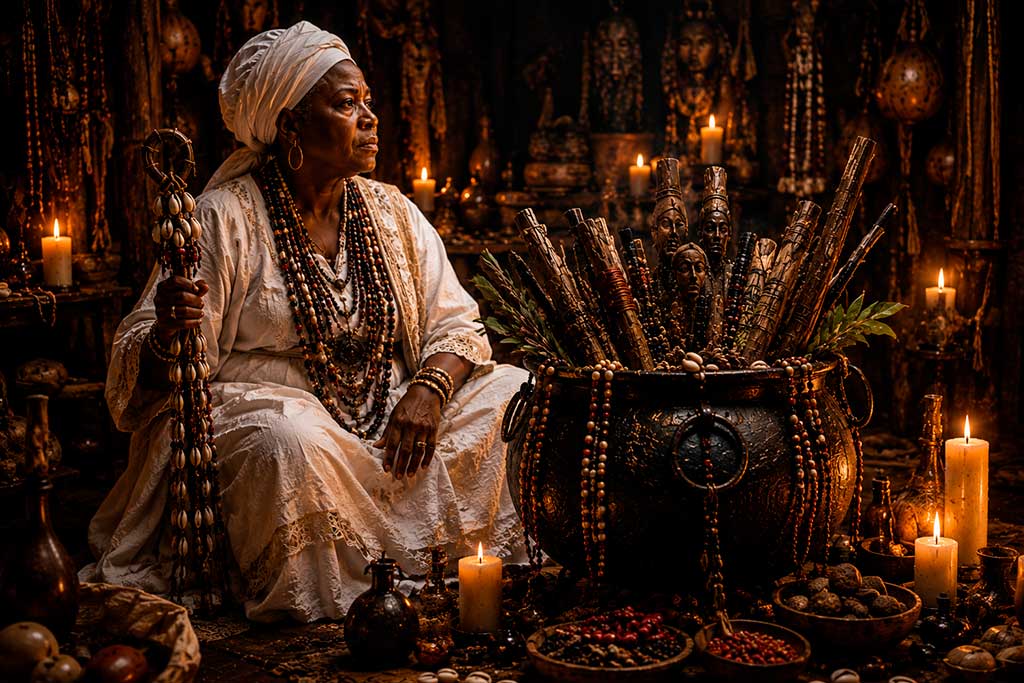
La Yaya Nganga o Yayi Nganga She is a high-ranking female religious authority. The expressions Ngudi Nganga, Mama Nganga, Madre Nganga, and other variants also appear in different sources.
He should not be defined as an assistant to the Tata. In houses studied in Cuba, Tatas and Yayis appear at the highest level of human authority: they teach, initiate, preserve knowledge, and participate in the creation and maintenance of foundations for advanced members.
A Yaya can lead a munanso and have godchildren. However, the role of women is not regulated equally in all lineages. Some houses recognize equal authority between Tata and Yaya, while others establish limitations related to gender, age, or menstruation.
Even within the same house, discussions about these restrictions can arise. An informant documented by Todd Ramón Ochoa maintained that, after menopause and receiving her prenda (sacred object), a Yayi Nganga (priestess) was equal to a Tata (priest) and should not be excluded from any Palo secrets. This testimony reveals a specific position within the tradition, not a rule automatically applicable to all houses.
The most reliable assertion is that women possess a historical and documented religious authority within Palo. The specific ceremonial scope depends on the rules of the munanso to which they belong.
Father Nganga and Mother Nganga
In some houses, the titles of Father Nganga y Mother Nganga They correspond to initiates with greater experience and consecrations higher than the Ngueyo degree.
These individuals may have received their own foundation born from the main garment of the munanso, participate in ceremonies reserved for advanced members, and assume important responsibilities within the house.
However, holding this rank does not necessarily mean having godchildren or wielding the same authority as a Tata or Yayi Nganga. The Father or Mother Nganga may continue under the guidance of their elders while expanding their knowledge and fulfilling the obligations corresponding to their position.
This category is not present with the same name or identical functions in all lineages. Some houses recognize equivalent degrees using other designations, while others organize the progression of their initiates in a different way.
What is a Ngueyo?
El Ngueyo, also written ngüeyo, engueyo or nguello, is the person who has entered the house through the scratching, the first recognized initiation in numerous lineages.
In Cuba it is also called new pineThis image presents him as a newborn within the forest and the religious family. The exact African etymology of “Ngueyo” is not fully resolved and it is not advisable to translate it simply as “son.”
A Ngueyo:
- He is an initiate. He is already part of the munanso and maintains obligations to his foundations.
- He is in the learning phase. Observe, listen, and receive knowledge according to your category.
- He does not possess full authority. He cannot assume the roles of Tata, Yaya, Father or Mother Nganga on his own.
- Participate in the life of the house. Attend celebrations and collaborate according to the rules of the lineage.
- It depends on their elders. Their religious actions must remain within the guidance of their godfather or godmother.
Being a Ngueyo is not a shameful position. It is the foundation of learning and can be maintained for a short period, many years, or a lifetime, depending on the person's path and the needs of the household.
How is authority organized within a munanso
El munanso It is the religious house and the community formed around its foundations. Each munanso is autonomous and maintains its own genealogy, rules, titles, and distribution of responsibilities.
There is no global organization responsible for appointing Tatas, validating Yayis, or standardizing ranks. Authority is transmitted within specific religious families.
A common pattern, documented in certain houses, can be represented as follows:
| Indicative level | General functions |
|---|---|
| Main foundation of the house. | Religious center of the munanso and spiritual authority superior to its human members. |
| Tata Nganga and Yayi Nganga. | Seniors of high rank, teachers and those responsible for religious leadership. |
| Father Nganga and Mother Nganga. | Advanced initiates, sometimes with their own foundation, who continue under the authority of the elders. |
| Bakofula, butler or other attendants. | Positions of trust with specific responsibilities, whose presence and functions depend on the house. |
| Ngueyos. | Initiates incorporated through scratching and placed in the learning stage. |
| Relatives and consultants. | People associated with the house who have not necessarily received initiation. |
The scheme should not be read as a rigid administrative pyramid. A house may have several Tatas, Yayis, Fathers, or Mothers, and relationships of seniority, ritual kinship, and access to foundations may be more important than the isolated title.
The Bakofula and other positions of trust
Bakofula It is one of the terms whose meaning changes most frequently between sources. In the house studied by Ochoa, it designated the principal male assistant of a Tata, equivalent to a butler or trusted steward. He could help with teaching and preside over activities when the Tata was busy.
Other authors link the name to the handling of gunpowder. Both explanations may originate from different families or from roles held by the same person.
The Bakofula should not be presented as the second-in-command of every munanso. It is a documented position, but its presence, gender, powers, and relationship with the steward vary according to lineage.
Other possible names include:
- Butler. Trusted assistant and organizer of certain religious tasks.
- Guardiero. Position related to custody and surveillance in some houses.
- Barrier. Name used in certain lineages for functions of entry, order, or protection.
- Godmother or godfather of the foundation. Person related to the birth or care of a specific garment.
- Older members of the household. Experienced initiates who uphold the teaching and internal order.
- Ceremonial attendees. Members authorized for specific tasks during a celebration.
The above names do not constitute an official list. A house may use them in another sense, add its own positions, or not recognize them at all.
How does one achieve the status of Tata or Yaya?
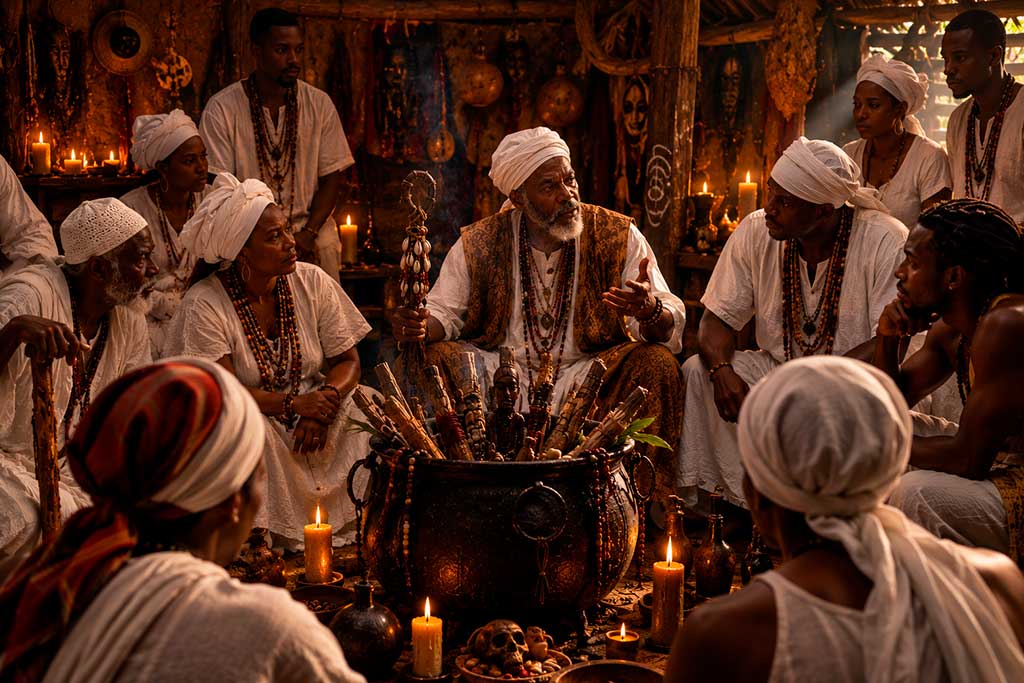
The status of Tata or Yaya is not assumed by personal choice. It is an authority granted within a religious lineage, after a process of initiation, learning, consecration, and recognition by the elders.
The process may include:
- Initiation inside a house. The person must belong to a specific religious genealogy.
- Learning. He acquires knowledge through observation, practice, listening, and oral instruction.
- Subsequent consecrations. Lineage can elevate the initiate to new responsibilities.
- Relationship with fundamentals. You may be granted access to or responsibility for an item according to the rules of your house.
- Recognition of the elderly. Authority does not depend solely on the opinion of the initiate.
- Behavior and ability. You must demonstrate that you can answer for religious obligations, people, and decisions.
- Authorization. Specific functions must be granted by those who have the authority to transmit them.
There is no universal number of years or minimum age valid for all houses. Nor is everyone required to progress to become a Tata or Yaya. The ranks correspond to the structure of the munanso and the religious path of each initiate.
Can every Tata scratch or deliver fundamentals?
No. Receiving the title of Tata does not automatically grant all possible powers.
The ability to manage a scratchingTo hand over a garment or to lead a consecration depends on:
- The branch. Mayombe, Briyumba, Kimbisa and other traditions maintain their own criteria.
- The ceremonies received. Not all Tatas have gone through the same consecrations.
- The authorization of the elders. A person can possess knowledge and not be authorized to transmit it.
- The foundation. Authority is also related to genealogy and the recognized abilities in the garment.
- The specific function. Consulting, initiating, providing foundation, and managing a house are not necessarily the same faculty.
Therefore, statements like “any Tata can scratch” or “only those who use a certain title can do it” should be avoided. The valid answer depends on lineage and the authorization received.
Does every Tata Nganga run his own house?
Not necessarily. A Tata can remain within the munanso of his elders and perform important functions there without founding an independent house.
To lead a new munanso, it is not enough to possess a garment. Recognition, the ability to vouch for initiates, and continuity with the lineage from which one originates are also necessary.
The indiscriminate creation of houses can fragment lineages and favor the emergence of individuals without sufficient training. For this reason, some elders delay or limit the authorization for an initiate to establish their own munanso.
How to recognize a responsible religious authority
Titles cannot always be verified through public certificates. Even so, there are signs that help assess the seriousness of someone presenting themselves as a Tata or Yaya:
- Can you explain your genealogy? Find out which house and elders he comes from, without having to reveal secrets.
- He does not confuse his abilities. Distinguish what you can do from what you have not been authorized to do.
- It does not promise guaranteed results. Avoid using fear or desperation to get money.
- Respect other people's homes. You can point out differences without declaring all other lineages false.
- He is responsible for his initiates. He does not disappear after the ceremony nor does he abandon teaching.
- It does not sell ranks. Ceremonial costs do not turn an initiation into a purchase of authority.
- It maintains limits. It does not expose secrets, it does not pressure to start, and it does not use the title to justify abuses.
Genealogy alone does not guarantee proper conduct. Religious authority must be accompanied by responsibility, clarity, and respect for those seeking guidance.
Differences between houses and branches
The hierarchies within Palo vary between branches and even between houses within the same branch. A term recognized in Briyumba may have a different meaning in Mayombe, Kimbisa, or Palo Monte.
The differences may affect:
- The names of the ranks.
- The relationship between Tata, Yaya, Father and Mother Nganga.
- The duties of the Bakofula or steward.
- Women's abilities.
- The moment when a person receives their own foundation.
- The ability to have godchildren.
- The requirements to open a munanso.
- The organization of the ceremonies.
When two sources offer different hierarchies, it doesn't always mean one is false. They often describe different houses. The comparison should be made by indicating the branch, location, and genealogy to which each explanation belongs.
Frequently Asked Questions about Tata Nganga
What does Tata Nganga mean?
It is a title of male authority within the Congo Rules. It combines Tata, father or elder, with Nganga, a term historically related to the ritual specialist and, in Cuba, also to the foundation.
Does all Tata Nganga run a munanso?
No. There can be several Tatas within the same house. The main leadership depends on the organization and internal recognition of the lineage.
What is the difference between Tata Nganga and palero?
Palero is a general term that does not, by itself, define a rank. Tata Nganga indicates a category of authority, knowledge, and responsibilities recognized by the house.
What is a Yaya Nganga?
She is a high-ranking female religious authority. She can teach, manage a house, attend to foundations, and vouch for initiates according to the rules of her lineage.
Can a woman lead a munanso?
Yes. There are houses led by Yayis or Ngudi Nganga. The specific powers and possible restrictions vary between lineages.
Can everything Tata scratch?
Not automatically. He must have received the necessary consecrations and authorization to conduct that ceremony within his branch.
Can a Tata deliver a nganga?
Only when their genealogy, their ceremonies, and their elders have granted them that authority. Possessing a garment does not, in itself, authorize the transmission of knowledge.
Is there an authority higher than all the Tatas?
There is no central institution for all of Palo. Each house responds to its own principles, its genealogy, and its religious elders.
Sources and editorial criteria
The hierarchies of Palo must be studied by examining specific houses. No single description automatically represents all branches.
Among the useful sources for understanding the organization of the munanso are:
- Todd Ramón Ochoa, Society of the Dead, especially his description of Tatas, Yayis, Padres, Madres, Bakofulas and Ngueyos in houses in Havana.
- Jesús Fuentes Guerra and Armin Schwegler, Language and rituals of Palo Monte Mayombe, for his study of ritual vocabulary and terms such as Tata Nganga and Ngudi Nganga.
- Judith Bettelheim, studies on Palo Monte Mayombe and the organization of its houses.
- Katerina Kerestetzi, research on the munanso, the foundations and the ritual autonomy of the houses.
- Contemporary studies on gender, authority, and religious transmission within the Congo Rules.
This content is historical and informative. Titles, faculties, and ceremonies must be confirmed within the religious genealogy to which each practitioner belongs.
This article is part of our section dedicated to Palo Mayombe and the Conga RulesTo learn more about related concepts, see also our explanations on the nganga or prenda, the nfumbe y the scratching.
Organization, initiation and fundamentals of Palo Mayombe
The authority of the Tata Nganga is only understood within the religious family, its foundations, and the initiation stages of each house. Explore the following content to learn how the munanso, the nganga, the nfumbe, and the different levels of learning are related in the Reglas Congas.