The 7 African Powers: who they are, their significance, and their purpose

The 7 African Powers They are a devotional group comprised of seven spiritual forces associated, in many Afro-Caribbean traditions, with important Orishas of the Yoruba pantheon. They are invoked together to ask for protection, health, prosperity, open paths, spiritual defense, strength in the face of difficulties, and balance in life.
In the Rule of Osha and Ifá, they are usually related to Eleguá, Obatalá, Orunmila, Oggún, Oshún, Yemayá and ShangóHowever, in spiritism and popular devotion they can also be understood as seven ancestral powers, seven African spirits, or seven forces syncretized with Catholic saints.
Therefore, speaking of the 7 African Powers requires distinguishing between the religious foundation of the Orishas, Afro-Cuban syncretism, popular spiritualism, and the devotional use of candles, necklaces, images, incense, colognes, or amulets associated with these forces.
Quick fact sheet of the 7 African Powers
| Element | Description |
|---|---|
| Name | 7 African Powers or Seven African Powers. |
| Thrilling Tradition That Captivates All | Afro-Caribbean devotion, Santería, popular spiritualism, and syncretic practices. |
| Associated Orishas | Eleguá, Obatalá, Orunmila, Oggún, Oshún, Yemayá and Shangó. |
| Principal function | Ask for protection, health, prosperity, strength, justice, opening of paths, and spiritual defense. |
| Popular element | Seven-colored candle, seven-power necklace, image, incense, flowers, water, and prayer. |
| Devotional use | They are invoked in times of need, danger, difficulty, cleansing, or spiritual request. |
| Warning | Popular objects should not be confused with formal foundations of Osha or Ifá. |
What are the 7 African Powers?
7 African Powers They are a spiritual group that brings together seven forces considered powerful within various Afro-Caribbean practices. In Santería and Regla de Osha, they are commonly identified with seven principal Orishas, although their popular worship has also developed in spiritualist, esoteric, and syncretic circles.
These powers represent essential aspects of human life: paths, peace, wisdom, work, love, motherhood, justice, strength, prosperity, and protection. That is why many people invoke them together when they need broad spiritual support, especially in times of urgency, conflict, illness, misfortune, or danger.
Devotion to the Seven African Powers is not always practiced in the same way. In some houses it is understood from a perspective closer to Osha and Ifá; in others, from a spiritualist one; and in popular devotion it is expressed through candles, images, necklaces, prayers, baths, incense, and objects prepared for protection or personal growth.
Who are the 7 African Powers?

In the most widespread interpretation within the Afro-Cuban tradition, the 7 African Powers are related to seven Orishas: Eleguá, Obatalá, Orunmila, Oggún, Oshún, Yemayá and ShangóEach one represents a different force and addresses specific aspects of life.
| Power | It represents | He is mainly asked |
|---|---|---|
| Elegua | Paths, doors, movement and communication. | Opening paths, protection, and opportunities. |
| Obatala | Peace, purity, head, justice and balance. | Health, calm, mental clarity, and harmony. |
| orunmila | Divination, wisdom, destiny and advice from Ifá. | Guidance, clarity, protection from mistakes, and a good destiny. |
| Oggun | Iron, work, war, mountains and material strength. | Defense, employment, work, strength and defeat of enemies. |
| Oshun | River, love, sweetness, fertility and prosperity. | Love, wealth, fertility, grace, and development. |
| Yemaya | Sea, motherhood, protection and origin of life. | Maternal protection, health, stability and family. |
| Shango | Lightning, fire, drum, justice and power. | Victory, strength, defense, leadership, and justice. |
This list may vary in some popular practices, especially when the Seven Powers are interpreted from the perspective of Spiritism or syncretic devotions. However, the grouping above is one of the best known in the Afro-Cuban context.
Meaning of each of the 7 African Powers
Each of the Seven African Powers represents a distinct force within the spiritual world. Although they are invoked together, each Orisha retains its own character, attributes, colors, and the type of help typically sought. Therefore, understanding their meaning allows for a better understanding of why this devotion is considered a union of paths, protection, wisdom, love, strength, motherhood, and justice.
Elegua
Elegua He is the master of the roads, the doors, the crossroads, and the opportunities. His energy opens and closes the way, allows movement, and connects human beings with spiritual forces.
Among the Seven African Powers, Eleguá represents beginnings, protection of the path, and the ability to resolve obstacles. He is invoked for openness, good fortune, defense against enemies, progress, and permission for spiritual endeavors to proceed.
Obatala
Obatala He represents purity, peace, the head, justice, morality, and balance. He is considered the father of the Orishas and the owner of heads, and is therefore invoked to calm, order, and refresh a person's life.
Among the Seven Powers, Obatalá brings serenity, mental clarity, health, harmony, and stability. His presence balances the strength of the other Orishas and helps maintain judgment, patience, and inner peace.
orunmila
orunmila He is the great diviner, witness to destiny, and possessor of the wisdom of Ifá. His words guide, warn, and reveal the paths a person must follow to avoid mistakes and better fulfill their destiny.
In the grouping of the Seven African Powers, Orunmila represents counsel, spiritual vision, profound knowledge, and the ability to interpret what is hidden. He is invoked for guidance, protection in difficult decisions, and clarity to avoid walking blindly.
Oggun
Oggun He is the master of iron, metals, the mountains, war, technology, and hard work. He is a tireless force, associated with defense, constant labor, and the ability to overcome obstacles through action.
Among the Seven Powers, Ogun provides strength, employment, protection from enemies, energy to move forward, and the ability to overcome difficult situations. He is also invoked in work-related matters, conflicts, and for spiritual defense.
Oshun
Oshun She is the Orisha of the river, love, sweetness, fertility, wealth, and charm. Her energy softens, attracts, fertilizes, and gives grace to life, though she can also be firm when defending justice and truth.
As one of the Seven African Powers, Oshun represents beauty, prosperity, love, femininity, sweetness, and development. She is invoked for help in matters of the heart, finances, family, and fertility.
Yemaya
Yemaya She is a mother, protector, and mistress of the sea. She represents motherhood, emotional depth, fertility, the origin of life, and the strength that sustains children through difficulties.
Among the Seven Powers, Yemayá provides maternal protection, health, stability, family, defense, and spiritual support. Her energy is associated with the sea, gestation, life, and protection in difficult situations.
Shango
Shango He is the Orisha of lightning, fire, thunder, drums, justice, power, and victory. He is a real and dominant warrior force, invoked when it is necessary to vanquish enemies, confront injustices, or regain authority.
In the Seven African Powers, Shangó represents strength, leadership, courage, justice, and triumph. He is invoked for defense, victory, steadfastness, spiritual power, and the ability to overcome adversity.
What is the purpose of the 7 African Powers?
The Seven African Powers are invoked for broad assistance in times of difficulty. By uniting diverse forces, their devotion seeks to address various aspects of life: paths, health, justice, love, work, protection, prosperity, and spiritual defense.
- Opening of paths: Eleguá is asked to remove obstacles and allow progress.
- Peace and health: Obatalá is invoked for clarity, calm, balance, and well-being.
- Spiritual guide: People turn to Orunmila for advice, destiny, and wisdom.
- Work and defense: Oggún is asked for strength, employment, protection, and the defeat of enemies.
- Love and prosperity: Oshun is invoked for sweetness, wealth, fertility, and development.
- Family Protection: People turn to Yemayá for protection, motherhood, health, and stability.
- Justice and victory: Shangó is asked for strength, leadership, defense, and triumph.
Invoking them should not be seen as an automatic process. In Afro-Caribbean traditions, every petition requires respect, faith, proper conduct, attentiveness, and understanding of the forces being called upon.
Colors of the 7 African Powers
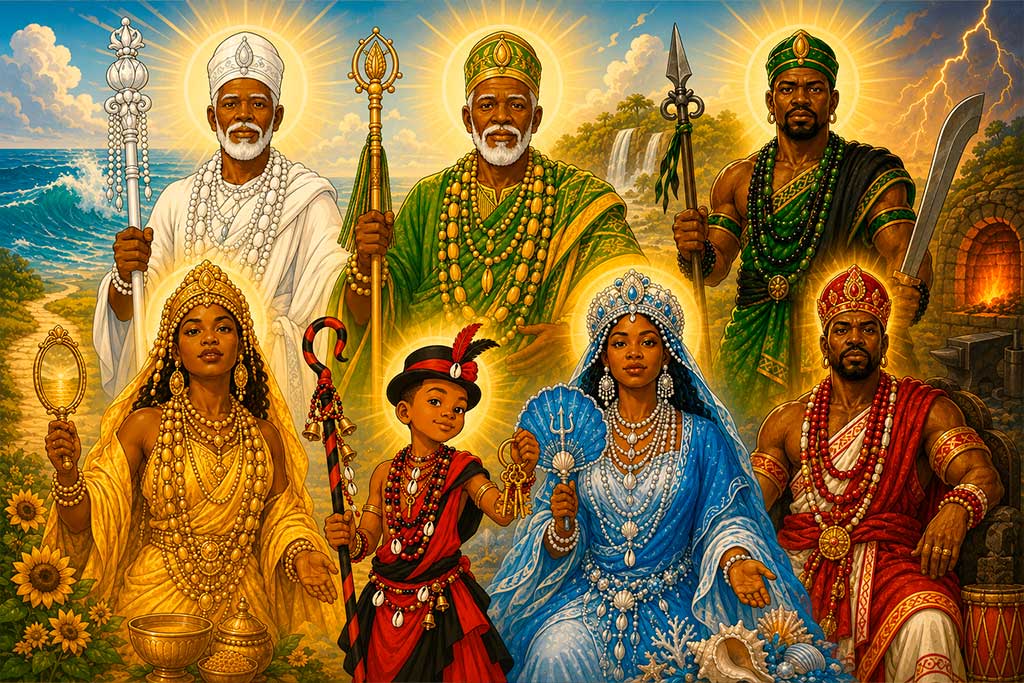
The colors of the Seven African Powers are related to the Orishas that make up this group. These colors appear on candles, necklaces, images, prints, bracelets, and other devotional objects.
| Power | Associated color | Spiritual sense |
|---|---|---|
| Elegua | Red and black. | Paths, protection, movement, and destiny. |
| Obatala | White. | Peace, purity, head, clarity and health. |
| orunmila | Yellow and green. | Wisdom, Ifá, destiny, guidance and advice. |
| Oggun | Green and black. | Iron, mountains, work, war and defense. |
| Oshun | Yellow, gold or amber. | Love, wealth, sweetness, river and fertility. |
| Yemaya | Blue. | Sea, motherhood, protection and stability. |
| Shango | Red and white. | Fire, lightning, justice, strength, and victory. |
In popular devotion, these colors are often integrated into the seven-colored candle and the necklace of the 7 African Powers, as a way of representing the union of all these forces in the same petition.
Candle of the 7 African Powers.
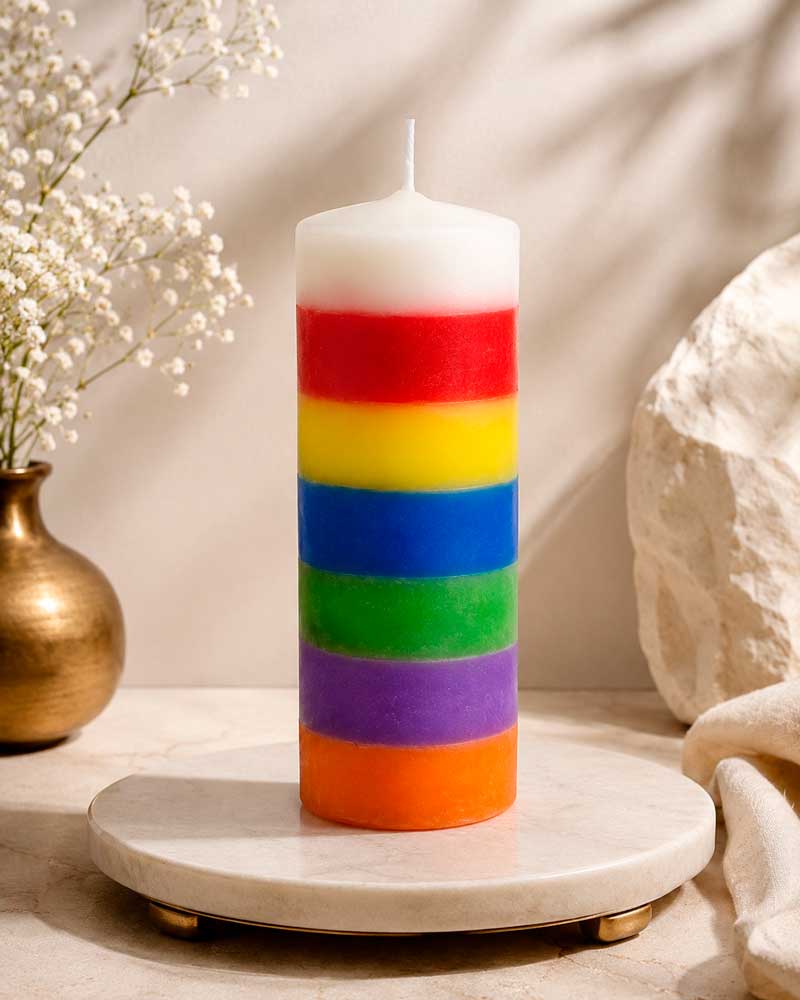
El candle of the 7 African Powers It is one of the most commonly used devotional objects for invoking these forces. It typically features seven colors that represent the Orishas or deities invoked during the petition.
It is lit to ask for protection, health, luck, prosperity, open paths, spiritual defense, or help in times of difficulty. In popular practice, it may be placed next to a glass of water, flowers, an image of the Seven Powers, incense, or other simple offerings.
The candle does not replace any formal Osha or Ifá ceremony. It belongs more to the realm of popular devotional, spiritualist, or esoteric practices, where light is used as a symbol of petition, clarity, and spiritual communication.
Necklace of the 7 African Powers
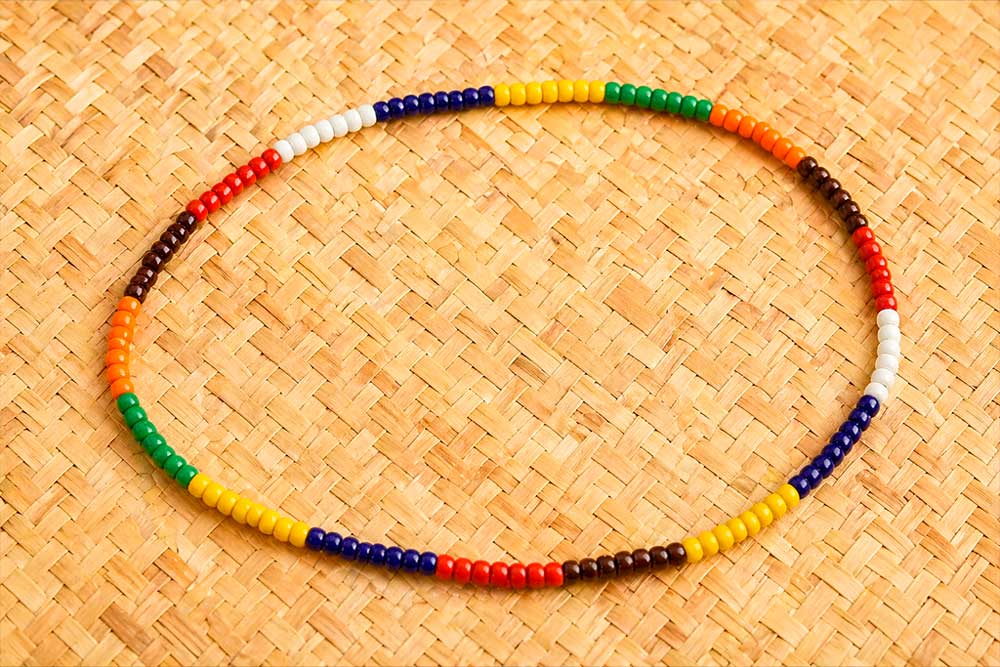
El necklace of the 7 African Powers It is usually made with beads of various colors associated with the deities of this devotion. In many folk traditions, it is used as a symbol of protection, strength, spiritual unity, prosperity, and support during difficult times.
It should not be confused with the Osha elekes received in ceremony. Although both use colors related to Orishas, the 7 Powers necklace may belong to the realm of popular devotion, while consecrated elekes have a specific ceremony, religious house, and rules for their delivery and use.
Its main purpose is to represent the joint presence of the seven forces, as if the wearer were walking accompanied by protection, justice, openness, sweetness, wisdom, strength, and spiritual motherhood.
Devotional objects of the 7 African Powers
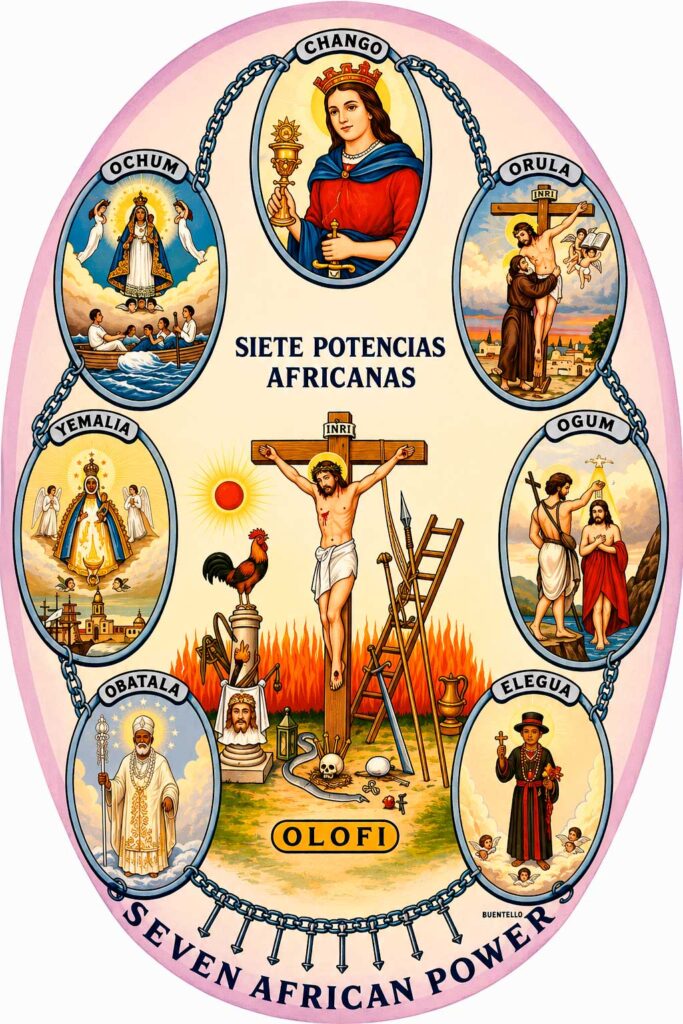
Devotion to the 7 African Powers is often represented by seven-colored candles, images, necklaces, incense, colognes, soaps, essences and other popular elements used in works of protection, cleansing, prosperity and opening paths.
These objects do not replace the religious foundation of the Orishas, nor do they automatically transform a practice into an Osha or Ifá ceremony. In many cases, they belong to the realm of popular devotion, spiritualism, or esotericism, where they are used as symbolic support for prayers, petitions, and spiritual offerings.
| Element | Popular use | Spiritual sense |
|---|---|---|
| 7-color candle. | It is lit to ask for protection, luck, openness, and spiritual help. | It represents the union of the seven forces in a single request. |
| Necklace of the 7 Powers. | It is used as a symbol of protection and spiritual guidance. | It brings together the colors associated with various deities or Orishas. |
| Image or print. | It is placed on altars, vaults, or prayer spaces. | It serves as a devotional focal point. |
| Incense. | It is used to clean and prepare the environment. | It represents purification, elevation, and spiritual opening. |
| Flowers and water. | They are placed as a simple and respectful form of service. | They express freshness, light, gratitude, and cleanliness. |
| Colognes, essences or soaps. | They are used in popular cleaning or attraction practices. | They belong more to the devotional/esoteric field than to the formal foundation of Osha. |
Therefore, when speaking of the 7 African Powers, it is important to distinguish between popular devotion—where candles, colognes or amulets are used—and the formal religious practice of Osha and Ifá, where each Orisha has its own foundations, ceremonies and rules.
How are the 7 African Powers being served?
In popular devotional practice, the 7 African Powers can be attended to with a seven-colored candle, a glass of water, flowers, fruits, coconut, honey, rum, tobacco, incense, cascarilla, cocoa butter, corojo oil, sweets or symbolic foods, according to the custom of the person or the spiritual guidance received.
A simple offering might include a clean space, an image or picture, a lit light, fresh water, and a respectful prayer. The intention is to ask for assistance, give thanks for protection, and raise the petition to the forces represented by the seven powers.
In more formal religious contexts, each Orisha has its own rules and should not be approached haphazardly. Therefore, when the practice relates to Osha or Ifá, it is advisable to seek guidance from older religious practitioners.
Prayer to the 7 African Powers
Many people invoke the Seven African Powers through prayers to ask for protection, health, prosperity, open paths, and spiritual defense. These prayers often combine elements of folk devotion, Catholic syncretism, and references to the Orishas.
The prayer to the Seven Powers usually names each of these forces to ask them to listen, protect, and grant help in times of need. In some cases, the prayer is recited before an image, a seven-colored candle, or in a space prepared with water and flowers.
If you're looking for a more direct request, you can read the prayer to the 7 African Powers, dedicated especially to those who wish to pray to them for help, protection, luck and development.
History and origin of the cult of the 7 African Powers
The cult of the 7 African Powers arises in the context of Afro-Caribbean religions, especially due to the arrival of African peoples in America during slavery and the need to preserve their beliefs in the face of colonial religious imposition.
In Cuba and other parts of the Caribbean, Africans preserved their religious practices through syncretism. Many Orishas were associated with Catholic saints, not because they were the same in origin, but as a way to protect, conceal, or express their worship within an environment dominated by Catholicism.
Over time, devotion to the Seven African Powers took shape as a grouping of spiritual forces capable of assisting the believer in different aspects of life. Thus, Yoruba, Afro-Cuban, Catholic, Spiritist, and popular esoteric elements were integrated.
The 7 African Powers in Spiritism
In Spiritism, especially in some popular traditions of the Caribbean and Venezuela, there is a different interpretation of the Seven African Powers. They are not always understood as Orishas in the strict sense, but rather as seven ancestral spirits, seven African forces, or seven entities linked to nature and the spiritual world.
In some spiritualist practices, they are associated with syncretized Catholic entities. Among the best-known associations are:
- Saint Anthony of padua: associated with Eleguá because of his relationship with roads, help and popular devotion.
- Our Lady of Mercy: associated with Obatalá for peace, whiteness and mercy.
- San Francisco de Asis: associated with Orunmila for wisdom, piety and spiritual service.
- Saint John Baptist: associated with Oggún for firmness, faith and strength of action.
- Our Lady of Charity of El Cobre: associated with Oshun because of her relationship with love, sweetness and protection.
- Virgin of Regla: associated with Yemayá because of her connection to the sea and sailors.
- Saint Barbara: associated with Shangó by lightning, strength, the sword and the color red.
These associations belong to the realm of syncretism and popular devotion. They should not be understood as absolute equivalences, but rather as historical and spiritual ways of relating African energies to Catholic imagery.
Spiritual work to the 7 Powers
In some spiritualist practices, spiritual rituals are performed in honor of the Seven African Powers. These may include a spiritual altar, glasses of water, flowers, tobacco, rum, chanting, prayer, the assistance of mediums, and cleansing the space.
When working from this perspective, the 7 Powers can be understood as ancestral forces or African spirits that are invoked to guide, cleanse, protect and spiritually strengthen the person or the house.
This type of work should not be confused with an Osha or Ifá ceremony. It belongs more to the spiritualist field and should be carried out with knowledge, respect, and guidance from people trained in that spiritual framework.
Ritual with the 7 African Powers for cleansing and protection
In popular devotion, there are also rituals dedicated to the Seven African Powers to ask for cleansing, protection, and spiritual defense against negative energies, envy, low vibrations, spells, witchcraft, or dark influences. This type of practice belongs more to the realm of popular devotional and spiritualist beliefs than to a formal Osha or Ifá ceremony.
It should be done respectfully, in a clean space, and without confusing it with a religious ritual. When the spiritual situation is intense, it is best to seek guidance before improvising practices that the person is unfamiliar with.
Necessary elements
- A candle or votive candle of the 7 African Powers, of seven colors.
- A white plate.
- Two glass containers with fresh water.
- Seven white roses.
- Seven red roses.
- Two dried coconuts.
- A glass cup with holy water.
- Incense of the 7 African Powers.
- A table with a white tablecloth.
- An image of the 7 African Powers.
How it is performed
Before beginning, the space is cleansed and prepared by lighting the incense. Then, the image of the Seven African Powers is placed on a table covered with a white tablecloth. In front of the image, the glass of water is placed, and in front of it, the seven-colored candle on the white plate.
On one side, the white roses are placed in a container of fresh water, and on the other side, the red roses in a second container. The person to be cleansed stands in front of the table, the candle is lit, and the cleansing is performed from head to toe with the two coconuts, while the corresponding prayer is recited.
In this holy hour and in this holy moment I implore the blessing of God the Father, Son and Holy Spirit.
I invoke the spiritual power of the 7 African Powers. Pure and ancestral spirits, ancient forces residing in nature.
May you, spirits of goodness, assist me in this work that I perform today at your feet. Allow my hands to be guided by your spiritual power to cleanse, protect, and relieve this creature of all spiritual illness.
I revoke and remove, in the name of the 7 African Powers, all evil, spells, enchantments, evil eye, incantations, dark work, burial, binding or spiritual harm that may exist against this creature of God whose name is: [say the person's name].
Thanks to the Seven African Powers, I conquer today and forever all darkness, whether incarnate or disembodied, with God's blessing before me. Amen, so be it.
After the cleansing is complete, the coconuts are taken to a corner and broken by throwing them backward, without looking back at where they fell. Once the candle has burned out, the flowers can be used to prepare a cleansing bath, according to the person's custom or spiritual guidance.
After the ritual, it is recommended to cleanse the space again with incense of the 7 African Powers to remove any low vibration that may have remained in the place.
Difference between the 7 African Powers and the Orishas
The Seven African Powers are often identified with seven important Orishas of the Yoruba pantheon, but they are not always understood in the same way in all practices. Within the Rule of Osha and Ifá, they are primarily associated with Eleguá, Obatalá, Orunmila, Oggún, Oshún, Yemayá, and Shangó.
However, within some spiritualist or devotional currents, they can be interpreted as seven ancestral forces, seven African spirits, or seven entities syncretized with Catholic saints.
Therefore, devotion to the Seven African Powers is broader and more popular than a formal Osha ceremony. It may be inspired by the Orishas, but it is also expressed in candles, images, prayers, necklaces, amulets, and spiritualist practices that do not always belong to the formal religious foundation.
Patakí of the 7 African Powers in Ifá: the path of Edibere
An Ifá path tells that, many years ago, a Yoruba king named Edibere He decided to set out to conquer a new territory. Before marching towards the land of Djalow, in Senegal, he went to consult the Awo of Orunmila. Babá Irete Mejito find out what he should do before starting the war.
The Awo explained to him that, before Orunmila came down to earth, there were spiritual forces known as NamenialaboThese forces worked at the will of Olofin. They kept among their secrets 21 Eggun organized into three groups: sky, sea, and earth.
Following Ifá's recommendation, Edibere was to address these forces and attend to the Seven African Powers in order to win the war that was about to begin. The work was organized into three levels:
- Sky: Seven plates with indigo and three doves on each one.
- Earth: Seven gourds with flour, scraps, jutia and smoked fish, palm oil, honey and a rooster for each gourd.
- Mar: Seven gourds with white flowers, sea fan, white roosters, shells, throne, wick lamp, stones, arrows, oil and other foundation elements.
Edibere performed the sacrifices indicated by Ifá. On the seventh day, he set out with his army to conquer, carrying the lit lamps, and left them in the mountains near the enemy territory.
When the inhabitants of Djalow saw those bright lights in the distance, they approached, but upon closer inspection, they perceived them as terrifying images and were filled with fear. At that moment, Odigbere's soldiers entered the city and seized the kingdom.
From this perspective, the intervention of the Seven African Powers appears as a force of protection, a spiritual strategy, and a path to victory in difficult situations. It is not simply a matter of invoking them out of necessity, but of recognizing that each realm—sky, earth, and sea—can participate in the defense and development of a person or community when Ifá so indicates.
Frequently Asked Questions about the 7 African Powers
What are the 7 African Powers?
They are a devotional group of seven spiritual forces associated, in many traditions, with important Orishas of the Yoruba pantheon.
Who are the 7 African Powers?
They are generally identified with Eleguá, Obatalá, Orunmila, Oggún, Oshún, Yemayá and Shangó.
What is the purpose of the 7 African Powers?
They are invoked to ask for protection, health, prosperity, opening of paths, love, justice, spiritual defense and strength in the face of difficulties.
What are the colors of the 7 African Powers?
Eleguá is associated with red and black; Obatalá with white; Orunmila with yellow and green; Oggún with green and black; Oshún with yellow or gold; Yemayá with blue; and Shangó with red and white.
What does the 7 Powers candle mean?
The seven-colored candle represents the union of the seven forces in a single request for protection, light, luck, cleansing, or spiritual help.
What is being asked of the 7 African Powers?
They are asked for opening paths, health, prosperity, defense against enemies, love, stability, justice, family protection, and spiritual guidance.
How are the 7 African Powers being served?
In popular devotion, they can be attended to with a seven-colored candle, water, flowers, fruits, incense, prayer, and a clean space prepared with respect.
Are the 7 African Powers Orishas?
In Afro-Cuban interpretation they are usually identified with seven Orishas, but in spiritism and popular devotion they can also be understood as ancestral forces or syncretic entities.
What is the necklace of the 7 African Powers?
It is a multicolored necklace used as a symbol of protection, spiritual union, and accompaniment of the seven forces. It should not be confused with the consecrated elekes of Osha.
Are the 7 African Powers the same as Catholic saints?
No. The associations with Catholic saints belong to syncretism. They are not absolute equivalences, but rather historical ways of relating Catholic imagery to African forces.