Palo Mayombe (Palo Monte): origin, beliefs and foundations

El Mayombe stick It is an Afro-Cuban religion with Kongo roots, formed in Cuba from knowledge related to the dead, the forces of nature, the forest, and consecrated foundations. It is also known as Palo Monte, Paleria o Conga RuleHowever, these names do not always have the same reach in all religious houses.
The nganga or prenda occupies a central place, along with the nfumbe, the mpungos, the palos del monte, the firmas, and the mambos. The practice is transmitted primarily within munansos and initiatory lineages, so the names, attributes, and procedures may vary from one house to another.
Note on the variants: This page presents historical and religious information of a public nature. When a practice depends on a specific branch or lineage, this is explicitly stated, rather than making it a universal rule.
What is Palo Mayombe?

Palo Mayombe is, above all, a relationship: between people, the dead, nature, and great spiritual forces called mpungos.
It is not limited to divination or spiritual practices. It encompasses a complete worldview, forms of religious kinship, initiation ceremonies, a deep knowledge of the forest, obligations to elders, and constant attention to the foundations of the home.
For the palero, nature is not inert matter. Trees, stones, water, earth, and metals possess spiritual qualities and actively participate in religious practices. Death is not a definitive break either: the dead maintain ties with the living, transmit knowledge, protect, warn, and intervene within a ritually established relationship.
That's why Palo has been described as the religion of the dead, the mountains, and sacred matter. None of those phrases, on its own, explains everything, but together they come pretty close.
Palo Mayombe, Palo Monte, Palería and Regla Conga: the names
Names change depending on the country, era, and lineage. It's important to be clear about them because they can cause a lot of confusion.
- Palo It is the most widespread general name, and it refers to the importance of the mountain, trees and natural materials in practice.
- Palo Monte It usually functions as an umbrella term for all conga traditions developed in Cuba, although in some households it has a more specific meaning.
- Paleria It is the popular name for the religion. Those who practice it are called paleros, mayomberos, tatas, or yayas, depending on their initiation and hierarchy.
- Conga Rule o Congo Rules It highlights the Central African root and the existence of different branches of transmission.
- Mayombe stick It is used as a general name —especially outside of Cuba—, but it also identifies a specific branch within the Reglas Congas.
- Mayombe o Mayumbe It is also the name of a forested region in West Central Africa historically linked to Yombe populations within the Kongo area. Therefore, it is not appropriate to simply translate the word as "magic trees": its religious use is tied to a broader geographical, cultural, and diasporic history.
This variety is not a contradiction. Palo has no central authority, single doctrinal book, or institution that imposes a universal terminology: transmission depends on houses, lineages, and elders.
Origin: from the Kingdom of Kongo to Cuba
The roots of Palo Mayombe lie in the religious traditions of the Bakongo people and other Central African populations linked to the Kikongo world. The ancient Kingdom of Kongo encompassed territories of present-day Angola, the Democratic Republic of Congo, and the Republic of Congo, where highly developed knowledge existed regarding ancestors, religious specialists, objects of power, healing, and divination.

During the transatlantic slave trade, numerous Africans from these regions were brought to Cuba, especially during the sugar boom of the 19th century. There they preserved and reorganized their languages, practices, and worldview. Palo did not arrive on the island as a finished religion: it was formed over centuries through the religious memory of Africans and their descendants, the cabildos (religious societies), family transmission, contact with Catholicism, and coexistence with the local population. Rule of Ocha or Santería and the influence of spiritualism.
It has deep African roots, but it is an unequivocally Afro-Cuban religion.
One fact that often surprises: not all the Catholic elements of Palo were "disguises" adopted during slavery. The Kingdom of Kongo maintained contact with Christianity from the late 15th century, so some of these religious associations may have crossed the Atlantic already established.
Nsambi, the creator
Nsambi, Nzambi, or Nsambi Mpungu is recognized in many houses as the creative principle and supreme authority: the origin of the world, of life, and of the order that sustains existence. The variations in his name are explained by oral transmission and the adaptation of Kikongo words to Cuban Spanish.
Although it occupies the highest position in cosmology, it does not usually receive the same ritual attention as the dead, the mpungos, or the fundamentos. Before certain ceremonies, its authority is acknowledged and permission is requested, while daily interactions are conducted with forces closer to human needs. In formulations that recognize it as a creator, it is not considered just another mpungo.
The mpungos of Palo Mayombe

The mpungos are great spiritual forces associated with realms of nature and human experience. There is no identical list in all houses: the names, paths, attributes, and associations change according to the branch and lineage.
The following table is for guidance only. It summarizes common attributes, but does not replace the teachings of a house nor does it intend to establish a universal pantheon:
| Mpungo | Main domains |
|---|---|
| Lucero world. | Paths, doors, communication and beginnings. |
| Saraband. | Iron, tools, work, war and defense. |
| Seven rays. | Fire, lightning, authority, and justice. |
| Chola Mom. | Rivers, prosperity, affection, and beauty. |
| Mother of Water or Mama Kalunga. | Sea, motherhood, protection and abundance. |
| Sparkle Ndoki. | Winds, storms, cemeteries and the dead. |
| Earth trembles. | Wisdom, creation, serenity, and authority. |
| Ngurufinda. | Mountain, plants, sticks and plant knowledge. |
| Kobayende. | Illness, death, transformation, and healing. |
| watariamba. | Hunting, defense, justice, and searching. |
In Cuba, associations were established between some mpungos and the orishas of Santería: Zarabanda is often compared to OggunSeven Rays with Shango and Mama Chola with OshunThese correspondences help to understand certain domains, but they do not transform the mpungos into orishas with Congolese names. Each tradition has its own foundations, stories, and ritual forms.
The nganga, prenda or fundamento

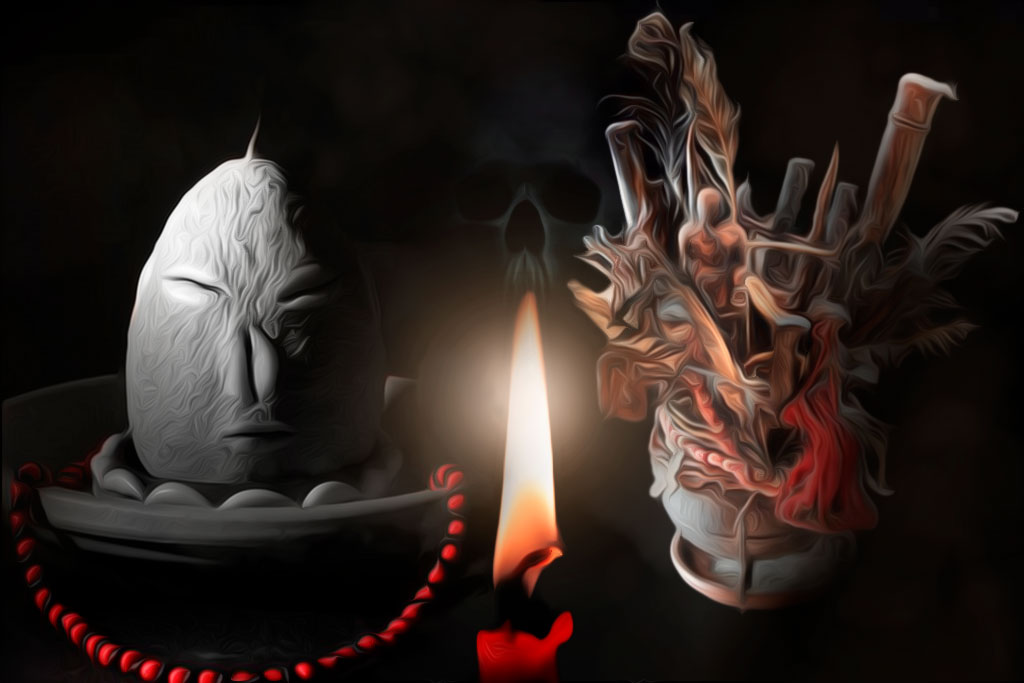
The nganga occupies a central position in Palo. It can also be called prenda, fundamento, or caldero, although these terms are not always used identically in all lineages.
From the outside, it may resemble a container filled with earth, sticks, stones, and metal. From a religious perspective, it is a consecrated foundation that embodies the power of an mpungo, the connection to a dead person, materials from the forest, elements linked to specific places, and the ritual authority of a house.
In many homes, the nganga is understood to possess will, the ability to communicate, and its own unique presence. It can be used in consultations, protections, cleansings, healings, and other rituals. It is not a collection of objects or an ornament.
Nganga, nkisi and garment: are they the same?
In the Kongo world, nkisi minkisi in the plural— can designate an entity or object charged with spiritual power, while nganga It was historically applied to the religious specialist who attended to him. In Cuba, the word nganga it came to be widely used for the central container or foundation, and garment It became another common name.
In contemporary religious usage, the terms may overlap, but they are not always exact synonyms. Some houses use nkisi to refer to strength or foundation; others retain it in titles, ritual names, or expressions specific to the lineage.
Not all ngangas They are prepared in the same way. Their components depend on the branch, the lineage, the mpungo, the function of the foundation, and the circumstances of its consecration. Their preparation belongs to the internal knowledge of each house and should not be presented as a public recipe or as a product that can be verified solely by its appearance.
What is the nfumbe?
The nfumbe or nfumbi is the dead person and the spiritual force associated with a deceased person. Depending on the house and the context, the word can refer to the spirit, the force of death, the bond established with a dead person, or the physical remains through which that relationship is manifested.
The popular image of the nfumbe as a mere “spiritual slave” does not adequately explain all the interpretations of Palo Mayombe. In many houses, the relationship involves care, obligations, and reciprocity: an alliance between the foundation, the Tata or Yaya, the deceased, and the religious family.
Nor should it be stated that all ngangas contain the same remains or that all houses function identically. There are significant variations and, in some contemporary contexts, ritual substitutions.
The use of human remains has generated legal controversy, especially when they come from desecrations or illicit activities. These cases exist and should not be hidden, but neither can they be used to portray the entire religion or all its practitioners as criminals.
The mountain or Nfinda
The mountain is not just a space with trees. It is a living territory inhabited by forces, matter, knowledge, and spiritual presences; that is why the word Nfinda appears constantly in prayers, songs, and ritual names.
The sticks, roots, vines, bark, and herbs each have different qualities, and their selection depends not only on the species: the place where they grew, their condition, and the religious purpose for which they are sought are all important. This knowledge requires years of apprenticeship with elders; it is not simply a matter of gathering any plant or copying recipes. Ngurufinda It is the mpungo most closely linked to this area, but the forest permeates the entire palera practice: from it come the elements for cleansings, protections, cures and foundations.
The branches of Palo Monte
Among the most frequently cited names within the Reglas Congas are Mayombe, Briyumba or Brillumba, Kimbisa, and Monte. Some genealogies speak of three main branches; others separate Palo Monte as a distinct tradition. Classifications vary among houses, and there is no institution that establishes a universal system.
Mayombe
Mayombe is characterized, in numerous descriptions, by a marked centrality of the nganga and by a direct relationship with the dead and the forces of the forest. Some houses present it as an orientation less influenced by other religious systems, but this characterization should not be automatically applied to all lineages. Outside of Cuba, “Mayombe” also functions as a general name for the entire religion.
Briyumba, Vriyumba or Brillumba
This branch retains numerous variations in name and lineage. Some descriptions emphasize the presence of mpungos, mystery, and specific forms of relationship with the nfumbe; others offer different characterizations. The long lists of sub-branches circulating online rarely indicate their origin and may correspond to particular houses, garments, treatises, or genealogies.
Kimbisa
The Kimbisa Rule of the Holy Christ of the Good Voyage is historically linked to Andrés Facundo de los Dolores Petit, a 19th-century Cuban religious figure. It is one of the branches with the most visible syncretism: it can incorporate elements of Congo, Catholicism, Spiritism, and, according to some sources, influences from Cuban fraternal societies. Its interpretation and value vary among different houses.
Palo Monte: branch or general name
Palo Monte is often used as an umbrella term for the Reglas Congas, but some classifications present it as a distinct branch. Therefore, before comparing "Palo Monte" and "Palo Mayombe," it's advisable to know how the house or source consulted uses those names.
The munanso: the house and the religious family
Books and historical research allow us to learn about Palo, but they do not replace its ritual transmission. Religious learning occurs primarily within the munanso: the house, the community, and the space where the sacred objects are tended to.
The munanso is a ritual family. Within it, relationships are woven between elders, godparents, godchildren, sacred objects, and guardian spirits, and each house preserves names, chants, signatures, and treaties that may differ from those of any other. Authority is not granted by knowing the prayers: it is granted by the initiation received, the religious genealogy, the years of apprenticeship, the care of the sacred objects, and the conduct toward elders and godchildren.
Tata, Yaya, Ngueyo and palero
Titles and responsibilities vary among lineages, but some designations appear frequently:
- El Tata Nganga He is a priest with the authority to conduct religious ceremonies and lead certain rituals in his home. “Tata” expresses respect for the religious leader; not every initiated man automatically holds the same rank.
- La Yaya, Yayi o Mother NkisiAccording to lineage, she is a priestess with religious responsibilities within the munanso. Women have held important positions in numerous households, although their specific duties are not identical in all of them.
- El Ngueyo It is an initiation that begins its learning and assumes obligations towards its house and elders. The initiation does not immediately make a person a Tata or Yaya: authority is acquired gradually.
- drainer o palera It is a general term for someone who practices or belongs to Palo. Within each munanso, ranks, received ceremonies, and individual responsibilities are more precisely distinguished.
The scratching: the initiation
The initiation ceremony, or "rayamiento," formally links a person to a Palo house and its lineage and principles. Its name refers to the ritual markings performed during the ceremony, although the specific procedures, prayers, and commitments are part of the internal knowledge of each munanso (house of initiation).
Initiation is not a fast track to power. It creates a new religious kinship, a commitment to the godfather or godmother, protections, rules of conduct, and gradual access to reserved knowledge. And not everyone needs to do it: that decision depends on consultation, the person's situation, and the judgment of their elders.
Expand on this information in our explanation about the meaning of the scratching in Palo Mayombe.
Divination: chamalongos, fula and vititi mensu
Divination allows one to consult the fundamental principles and interpret the position of spiritual forces in a given situation. The most commonly mentioned methods are:
- The chamalongosPieces are thrown to obtain answers based on how they fall. Their interpretation depends on the positions, the question, the foundation consulted, and the priest's knowledge.
- The fula or gunpowder, used in confirmation procedures: the way it burns and reacts is interpreted within the ceremonial context. It is not a recreational practice and should not be handled outside of a suitable environment.
- The vititi mensu, related to the ability to see what is not obvious, and the mpaka, a foundation prepared in a horn or other support, whose characteristics vary between houses.
Added to this are dreams, trance, and... mediumship, complementary means of communication with the foundation and the dead.
Learn more How are the chamalongos used in Palo Mayombe divination?.
Signatures or patipembas

The signatures—also called patipembas—are ritual markings that identify, summon, command, or express specific forces. They consist of lines, crosses, circles, and arrows whose meaning depends on the house, the foundation, and the purpose of the ceremony. A signature may be linked to an mpungo, a nganga, a petition, a priest, or an entire house; some are known within the lineage, while others are personal and secret.
The idea that white signatures (made of chalk or powdered chalk) are always "for good" and those made of charcoal or gunpowder "for evil" is widespread. The reality is less symmetrical: the materials and their functions depend on the specific treatise and the corresponding work. What is constant, however, is that signatures are not decorative drawings or symbols that can be copied without context.
Mambos, prayers and the Palo language
Mambos are the songs used to call, greet, and accompany each ceremony. The Palero language combines Kikongo with Cuban Spanish, and centuries of oral transmission have produced variations in spelling and pronunciation: Nsambi, Nzambi, or Sambi; mpungo or mpungu; Kimbisa or Quimbisa; Ngurufinda or Gurunfinda. In most cases, these are not distinct entities, but rather phonetic adaptations preserved by different groups.
A word of warning to anyone trying to translate songs word for word: it doesn't work. Many mambos contain ancient expressions, lineage names, and formulas whose full meaning only exists within the ceremony.
Collars, flags and protective amulets
Some houses use necklaces, chains, flags, bags, and other amulets as protection, religious identification, or to extend their connection to the sacred object. Their names, materials, and methods of presentation vary according to the lineage.
The so-called "death necklace" or "flag necklace" is documented in certain houses, but there is no universal model, nor can it be stated that all paleros must receive it, wear it daily, or place it in the same way. In some lineages, it is reserved for initiates; in others, its functions and rules of use are different.
There are also chains, small tools, and metals associated with forces such as SarabandTheir religious value does not depend on their appearance or the sale price, but on the ceremony, the house, and the authority of the person who prepares or delivers them.
Palo Mayombe and Santería: they are not the same
Palo Mayombe and Regla de Ocha or Santería are Afro-Cuban religions and have coexisted for centuries, but they come from different cultural matrices and retain their own foundations:
| Mayombe stick | Rule of Ocha or Santería |
|---|---|
| Roots primarily Kongo and Central African. | Roots primarily Yoruba. |
| He works with mpungos, the dead, and foundations such as the nganga. | He works with orishas and foundations specific to Ocha. |
| The forest, the sticks and other natural materials occupy a central place. | The otanes and attributes of the orishas fulfill specific functions. |
| The munanso organizes the religious family. | The house of the saint organizes religious kinship. |
| Their ritual language retains a Kikongo base. | Their ritual language retains a Yoruba or Lucumí base. |
A person can be initiated into Palo and also belong to Ocha or Ifá, but each tradition maintains different ceremonies and foundations. Presenting Lucero as if he were simply Elegua, oa Zarabanda as if it were only Oggún, erases important religious differences.
Is Palo Mayombe good or bad?
Classifying an entire religion as good or bad doesn't withstand serious scrutiny. Within Palo, there is protection, healing, spiritual cleansing, consultation, and addressing personal conflicts; there are also concepts of ritual aggression, defense against enemies, and retribution. This ambivalence isn't unique to Palo: many religious traditions distinguish between protecting, punishing, and responding to a threat. Conduct depends on the individual, the house, and the boundaries set by elders.
Much of Palo's bad reputation stems from other sources: the colonial persecution of African religions, the historical association between the word "sorcerer" and criminality, the sensationalism of films and news reports, and the confusion with Satanism or isolated criminal cases. There have been desecrations of cemeteries and individuals who have used religion to justify crimes; these cases should be judged individually, not projected onto all munansos and practitioners.
Is it Satanism?
No. Palo Mayombe does not originate from Satanism nor does it revolve around the Christian figure of Satan. Its cosmology arose from Kongo traditions and their transformation in Cuba: it recognizes Nsambi as the creator and works with the dead and natural forces according to its own concepts. The connection with cemeteries and bones has led outside observers to associate it with the diabolical, but this interpretation stems from cultural fears and categories foreign to religion.
The expansion of Palo Mayombe
From Cuba, Palo spread to the rest of the Caribbean, Venezuela, Mexico, the United States, and Spain, generating new houses and variations. This expansion, coupled with the internet, also brought problems that should be understood before approaching the religion: people presenting themselves as Tatas without verifiable lineage, the sale of supposedly consecrated ngangas, the publication of signatures without authorization, promises of guaranteed results, and content that reduces Palo to love spells and domination.
Understanding this religion requires consulting reliable sources, respecting religious houses, and accepting that much knowledge is not publicly available. The books—Lydia Cabrera and her El Monte They remain the classic gateway—they help to understand the history and terminology, but the ceremonies and responsibilities are only learned from authoritative elders within a munanso.
Sources and editorial criteria
This content has been compiled from historical, linguistic, and anthropological sources, contrasting classical descriptions with contemporary research. No consecration recipes or secret house knowledge are included.
The main references include:
- Lydia Cabrera, El Monte.
- Lydia Cabrera, Rules of Congo: Palo Monte Mayombe.
- Jesús Fuentes Guerra and Armin Schwegler, Language and rituals of Palo Monte Mayombe.
- Todd Ramón Ochoa, Society of the Dead.
- John K. Thornton, studies on the Kingdom of Kongo and Palo Mayombe.
- Erwan Dianteill, research on the transformations of the Kongo religion in Cuba.
- Katerina Kerestetzi, studies on the nganga, materiality and ritual space.
Lydia Cabrera's works are fundamental as an archive of Afro-Cuban voices, terms, and practices, but they should not be treated as a single doctrine. Every specific statement must be read considering the branch, era, and lineage from which it originates.
Frequently Asked Questions about Palo Mayombe
Are Palo Mayombe and Palo Monte the same thing?
Palo Monte is often used as a general name for the Reglas Congas, while Palo Mayombe can refer to both the entire tradition and a specific branch. The exact usage depends on the house, country, and lineage.
What is a nganga?
A sacred foundation where the power of an mpungo, the connection with a dead person, natural materials, and the religious authority of a house converge. It is not a decorative cauldron nor an object that can be bought ready-made.
What is an nfumbe?
The dead person or the spiritual force of a deceased person. In certain contexts, it also refers to the remains through which that relationship is materialized.
Who is the main god of Palo Mayombe?
Nsambi or Nzambi, recognized as creator and supreme authority. The mpungos and the dead are the forces closest to daily practice.
What are mpungos?
Great spiritual forces associated with domains of nature and human life: fire, iron, roads, rivers, the sea, the mountain or cemeteries.
Is a palero the same as a santero?
No. The palero belongs to the Reglas Congas; the santero, to the Regla de Ocha. A person can participate in both traditions, but their initiations and foundations are different.
What does Mayombe mean?
Mayombe or Mayumbe is the name of a forested region in West Central Africa and is historically linked to Yombe populations within the Kongo area. Within the religion, it can designate a specific branch or be used as a general name for Palo.