
Santa Bárbara Bendita, history, Prayer and Image

Saint Barbara Blessed, is identified as a symbol of faith, chastity, and martyrdom. It is highly revered in many parts of the world. Its adoration has transcended beyond Christian customs, and despite its antiquity, it remains in force to this day.
Who is Santa Barbara?
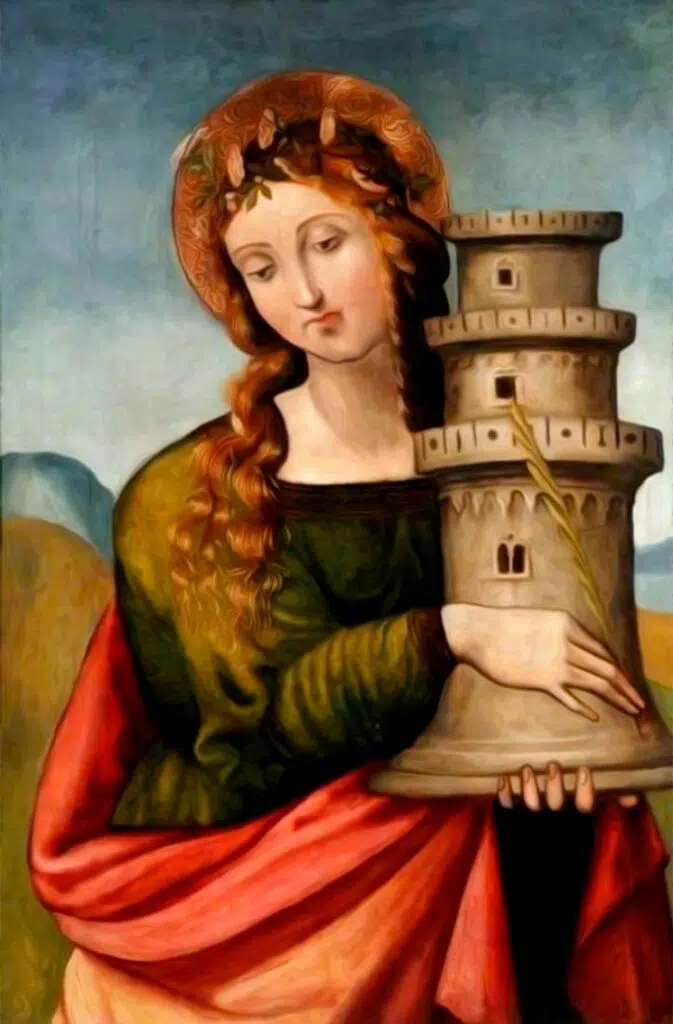
Her original name was Barbara de Nicomedia. In Greek languageː Ἁγία Βαρβάρα; and in Latinː Barbara Heliopolitana vel Nicomediensis. It is about a Christian martyr, whom the Catholic Church canonized for her unshakable faith in Christ.
Barbara is believed to have been born in AD 273 or at least the beginning of the XNUMXrd century. The place of birth has two hypotheses, some affirm that its place of origin was the city of Nicomedia, located in the adjacencies of the Sea of Marmara in modern Turkey; others refer that his birthplace corresponds to the city of Baalbek, known as the Heliopolis of Phenicia, which is now Lebanon.
It is estimated that he died in 306 AD, at the age of 33, in the city of Nicomedia, belonging to the Roman Empire, by beheading.
The attributes related to Santa Barbara are: a ray, a palm, a crown with a host, a chalice and a tower that has three windows.
History of Santa Barbara, an example of faith

It is said that Barbara was the daughter of a ruthless man known as: Dioscorus. He locked her up inside a castle, because he wanted to avoid her early marriage or to be interested in Christian beliefs that represented great controversy for the time. However, he allowed himself to be educated.
During her captivity she was educated in various subjects, such as poetry and philosophy. But, his father could not be aware of the details of his apprenticeship since, he stayed a long time away from his lands. That absence was taken advantage of by Barbara who became interested in knowing the doctrines of Christianity, until she became the Catholic faith.
After being baptized, she asked that another window be opened in her room, in order to have three of them, which would symbolize the Holy Trinity. One day her father went to see her to inform her that he had offered her in marriage, but she firmly declared herself a Christian and did not accept the order imposed by her father that would force her to marry, stating that she had already chosen Christ as her husband.
Her father, a follower of the pagan gods, immediately wanted to assassinate her in honor of their gods, but Barbara managed to flee by taking refuge in a rock, however, she was captured. A horrible martyrdom was applied to him to try to make him renounce his faith, but despite this, Barbara resisted the scourges and tears of her skin caused with iron rakes, and the burns with red-hot iron.
Finally, her own father sent her to trial where capital punishment by beheading was ordered. Dioscorus himself decided to carry out that order without caring that it was his daughter, taking her to the ridge of a mountain and beheading her mercilessly, leaving her body in that place. Moments later, while descending the mountain, he was struck by lightning, also dying immediately.
Image of Santa Barbara

The image of Santa Bárbara is loaded with a lot of symbolism. We can observe her with a young figure, with quite soft features, who carries a sword. That weapon refers to the way in which he dies, it should be noted that this element does not represent a symbol of war, on the contrary it refers to his absolute and unshakable faith.
She is also the bearer of a palm or olive branch in reference to her martyrdom, or of peacock feathers that are a symbol of resurrection or immortality. Another reference to his faith is the representation of the castle or the tower with three windows as the presence of the Holy Trinity in his life.
Your crown can have different characteristics; in some occasions it is classic like that of the princesses; in others, it is composed of towers, or ostias, due to its baptism and conversion to Christianity; in fact, the ostia and the chalice often appear in his images for the same reason.
Another important symbol that identifies her is the lightning bolt, which refers to what happened to her father after committing that horrible crime against him. Finally, her silhouette is always covered by a red cloak, representing the blood of Christ that covers her.
How was the cult of this Saint born?
It is said that from the beginning, the tomb of Saint Barbara was revered by Christians who attributed miraculous cures to it. It was thus that his fame became known after his death, gaining strength in the 1568th century. At that time, some of his relics were transferred to Constantinople and later to Venice. However, it is for the year XNUMX, that her veneration is recognized by Saint Pius V. In any case, Saint Barbara from her death to the present awakens the faith of many believers, even belonging to different religious cultures due to its moving history, symbol of true faith.
What relationship does Santa Bárbara have with the Orisha Chango belonging to the Yoruba pantheon?
It is well known that Santa Barbara enjoys the worship of people who belong to a variety of cults or religions. During the colonization of the "new world" Africans belonging to various tribes were transferred against their will to be enslaved in America. In that process, they were also forced to renounce their beliefs, giving way to a syncretism between their deities and the Catholic saints, in order to keep their faith alive.
In this process, the syncretism between the Orisha Shango and Santa Bárbara, motivated by the symbolic similarity between their attributes. Among its most outstanding similarities we have:
- Santa Bárbara uses the colors red and white, also representative of Changó.
- The cup he holds in his hand is compared to the mortar where he keeps his lightning stones.
- He has a double-edged sword that resembles the double-bladed ax wielded by the Orisha.
- The castle is part of the image of Santa Bárbara and Chango is called "Alaafin", whose translation is: Owner of the Castle.
- Santa Barbara has a crown and Chango is undoubtedly king.
- Santa Bárbara holds a palm branch in her hand that in the Catholic Church represents the devotees who have died by martyrdom, and for Chango the Palm is its representative plant.
What is required of Santa Barbara?
- Your protection is requested when you are outdoors, as it protects against lightning and storms. In some regions of Spain it was customary to ask him when storms were approaching. A very common phrase is: «Oh, Santa Bárbara, that thunders! Or blessed Santa Barbara, who brings the sun and takes away the thunder ». Elements were also used to "hide" the storm, such as knives and sickles with the edge towards the clouds, scissors with the point upwards, or bundles of salt were thrown into the fire. In other regions, a cross with salt is placed on the upper part of the door, while praying three times: "Blessed Saint Barbara, in heaven you are written with paper and holy water."
- The opposite is also requested, that is, it is asked to rain in arid regions but not to overdo it in storms, praying the following prayer: "Blessed Santa Barbara, who brings the sun and takes away the thunder, blessed Santa Barbara that in heaven you are written, with paper and holy water. Our Father, amen, Jesus.
- Your help is asked to strengthen our faith in difficult times; to maintain integrity and achieve our goals; and to understand the plan or destiny that we must fulfill when circumstances overwhelm us.
- People who perform work that involves electricity, fire, or risks due to being exposed to elements of nature (such as miners or stonemasons), request their protection during the execution of their work so that Santa Bárbara does not allow those elements to harm them in any way. no way.
- Women who suffer mistreatment or abuse of domestic violence of some nature, also ask for your intervention to get out of these situations without putting their physical integrity at risk.
- The farmers also ask for his help and to irrigate their fields with his holy water so that they give good harvests.
Santa Barbara celebration
The feast of Santa Bárbara is celebrated on December 4, the date on which it is considered his birth. In many parts of the world a great celebration is held in his name, according to local customs, but all of them have in common that they are carried out with great faith and great joy.
In Arab countries such as: Syria, Lebanon, Jordan and Palestine the "Aaid al Barbara" festival is celebrated every year. In it, children perform songs in his honor through the streets while asking for sweets. In addition, decorations similar to those of Halloween are usually hung in the front of the houses during that day, with lights and lanterns lit. Special dishes are prepared based on wheat grains, pomegranate seeds, raisins, anise and sugar, which are given to the little ones in disguise. This is done because it is believed that Santa Barbara disguised herself on several occasions to flee from the Romans.
In Lebanon, particularly, it is believed that while Santa Barbara was being persecuted, she ran through a freshly sown wheat field, which began to grow behind her instantly, erasing her tracks and hiding her from danger. That is why in its celebration wheat seeds or other grains such as: chickpeas, barley, beans, lentils, among others, are sown. After the seeds have germinated, they usually reach approximately 15 centimeters by Christmas, and the shoots are used to decorate the crib, or place them under the tree.
In Italy, especially in Paternò, province of Catania, various celebrations are held in his honor on December 4 and on other dates of the same month, as well as May 27 and July 27. Its festivals are considered one of the most beautiful Catholic celebrations in the country.
In America due to syncretism, the feast of Santa Barbara enjoys a lot of joy. In countries like Venezuela and Cuba, they are usually accompanied by songs and dances to the beat of the drum, where their devotees meet every December 4 in many places in various cities, where they share, and they offer them huge fruit squares, loaded with bouquets of flowers and many candles.
Patronage
Due to its history and attributes, Santa Bárbara is the patron saint of:
- Professions that handle explosives. Because of what happened to the lightning after his death.
- The military who belong to the navy of the majority of the armies of the world, including those of some Muslim countries.
- From electricians, fairies, blacksmiths and foundries.
- Of the miners and stonemasons. That is why in some of his images he is next to stone blocks.
Prayer to Santa Barbara
«Saint Barbara blessed, virgin and martyr, extraordinary of incalculable power.
God bless you and you to me on the paths of good.
With your powerful sword save me from all evil, injustice, betrayal and evil eyes.
With the strength and power of lightning, defend me from my enemies.
Exalt the fire output of my cannon and make it triumphant.
With your chalice and its wine, strengthen the energy of my body and nourish my spirit to survive setbacks and adversities.
Receive my lights, fruits, and flowers as a humble offering, a sign of my devotion to you, who are always present in my thoughts and in my lives.
I implore you to always keep me, and come to me every time I call you to defend my faith, my family, my goods and my wars; to be constantly victorious because you always accompany me. Amen."