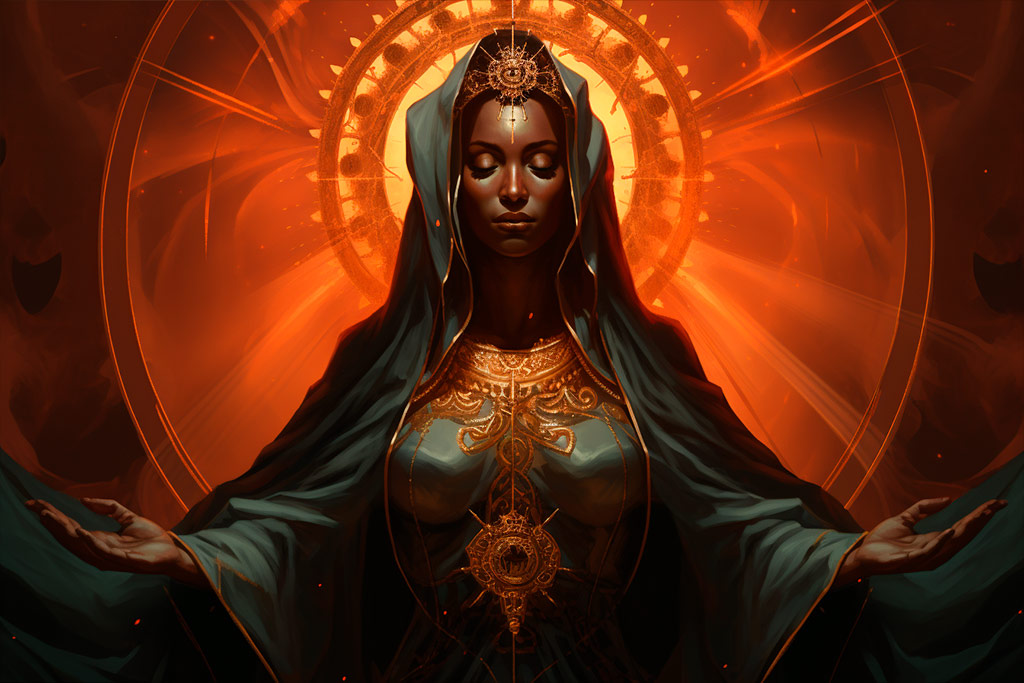
Saint Rita of Cassia

Popularly known as the lawyer or patron saint of the impossible, Santa Rita de Casia was a faithful Italian devotee who has been a representative of the faith in Christ and the Catholic Church. Her multiple miracles before and after her death make her followers blindly trust her valuable intercession to solve her problems.
Who is Santa Rita de Casia?
Santa Rita de Casia is a Catholic nun who was born on May 22 in an Italian village known as Roccaporena, in 1381, and died in Cascia on May 22, 1457, at the age of 76. Her given name was Margherita Lotti, however she was known as Rita, probably an abbreviation of her original name.
What is being asked of you?
The devotees of Santa Rita are not limited to a specific type of requests due to the great miraculous capacity that this saint enjoys. However, the most common requests that are usually made are:
- To heal all kinds of diseases and injuries.
- To solve sentimental and marital problems. For couples going through marital crises. Especially when women are victims of abuse, mistreatment, and domestic violence.
- In the presence of causes impossible to solve without divine intervention.
- When we are victims of loss and injustice.
- To protect mothers, or entrust the protection of children.
- To protect family members and home.
- Santa Rita de Casia is asked to attract peace and tranquility.
- Faced with desperate situations, suffering and agony.
History of Santa Rita de Casia
It is estimated that Santa Rita is born to elderly parents. From a very young age, she expressed her desire to be a nun, however, her parents did not approve her desire, and she was offered in marriage, by arrangement, as was the tradition of the time.
Her husband was a man from her town named Paolo Mancini. It is said that he was quite violent and infamous, which caused Rita great suffering, finding comfort only in prayer and faith in Christ. Even so, it is believed Rita managed to get Mancini to accept her conversion before ending her life.
From that union two twin sons were born, Jacobo and Paolo, who died of natural causes when they were very young. When Rita found herself without family obligations, after several previous attempts, she was finally accepted into the convent, she took the habit of a nun, and from there she dedicated herself to her profession of faith. By that time, she was already 36 years old. Her life as a religious was spent full of prayer and unwavering penance.
Santa Rita de Casia died in the Augustinian convent on the same day of her birth in 1457. As was the custom, the people close to her gathered at the place to pay the corresponding funeral honors, when they suddenly realized that an intense intensity emanated from her body. sweet fragrance, as if it had been embalmed. This was accompanied by a special phenomenon, since the body of the nun, although dehydrated, lies incorrupt in her coffin from that moment until today.
Miracles
There are many miracles that are attributed to Santa Rita de Casia. Some of those related to this blessed while she was alive are:
- The birth of Santa Rita: her parents were quite old, but they were characterized by being a charitable couple, believers and fervent at heart. Their relationship was very loving and brotherly. But, they suffered for not having been able to have children. It is said that while her mother, Aimée Ferri, prayed deeply making that request, she had the revelation in which she understood that the Lord would intercede for her cause. Indeed, after nine months, the couple would receive their first daughter into this world, who they would affectionately nickname Rita, as a diminutive of Margarita.
- The miracle of the bees: it is said that while her parents were working in the fields, they placed their little daughter inside a basket, where the bees began to settle. Another farmer, who was in the place, had previously been wounded in the hand, and by chance, he noticed that the girl was covered in bees, some were even inside her mouth. As a gesture of help, the farmer waved his injured hand over the girl to scare away the bees, but they had not caused her any harm, and to his greatest astonishment, his injury healed completely, instantly. Bees are a powerful symbol that has accompanied Rita on many occasions, in fact, when she became a nun, a large swarm settled on the walls of the monastery where they have remained until today, and they only come out when their celebration is commemorated in the month of May of each year.
- The miracle of the grape: on one occasion, to prove her obedience, the Mother Superior ordered Sister Rita to water a dry vine stock daily. Despite the absurdity of her request being evident, Rita took this task very seriously. After doing it for a whole year, a miracle happened, that dry branch turned green, growing lush and prospering with excellent fruit. To date, this tree is preserved in the Casia convent reaching more than five hundred years with a production of very high quality grapes.
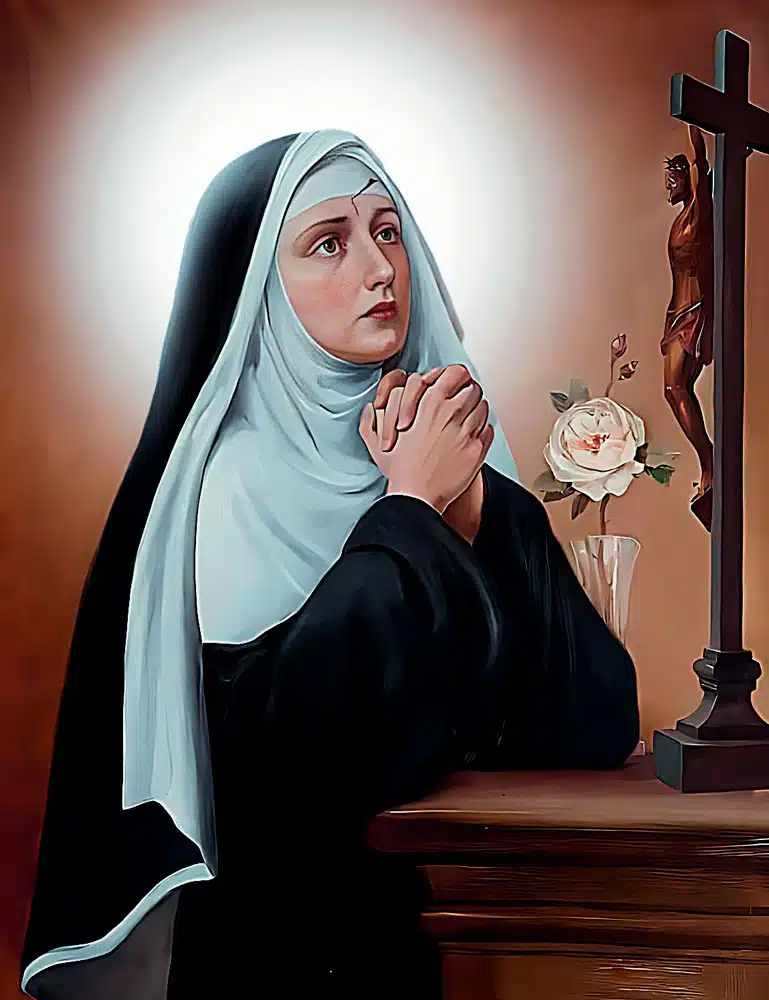
- The miracle of the roses: this is one of the most representative symbols of Santa Rita. She said that when she was married she used to feed the most needy, a gesture that her husband strongly condemned. One day, when she was preparing to carry out that mission, she hid a quantity of bread among her clothes, being discovered by her vile husband who, to prove his suspicions, ripped off her clothes, hoping to find proof of her disobedience, however, he did not It was like this. Those foods were transformed into roses, leaving the man totally confused. These kinds of miracles were also experienced by Saint Elizabeth of Portugal and Saint Diego de Alcalá. Usually, the image of Santa Rita is represented holding roses, or with roses lying on her feet.
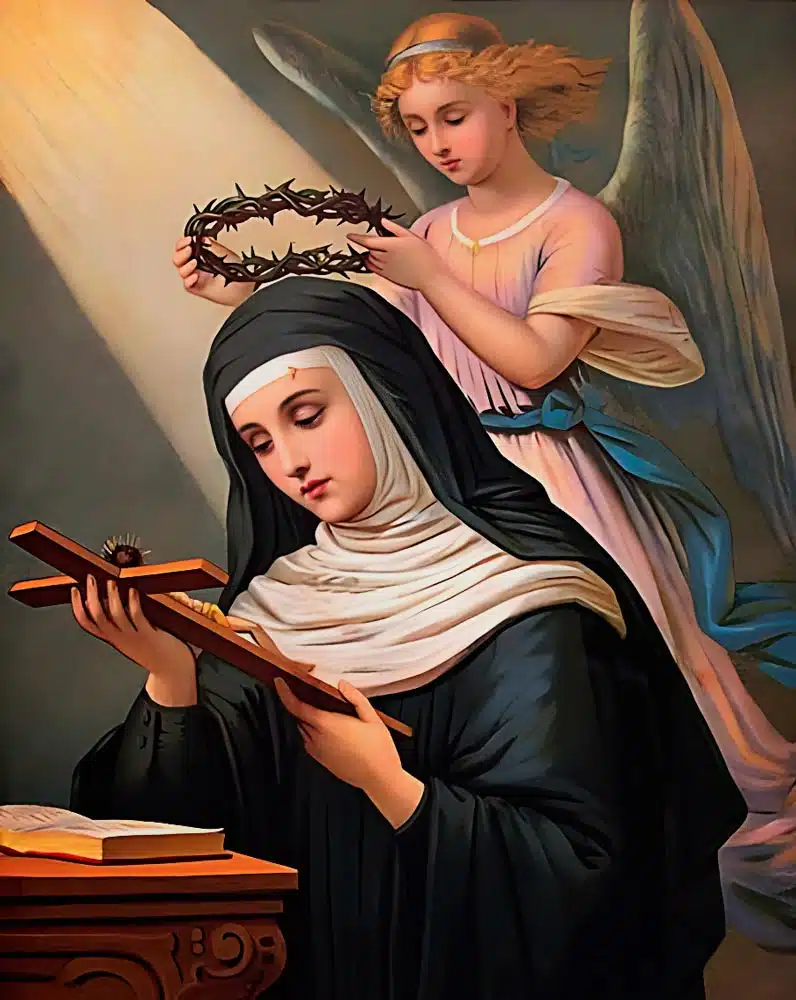
- The miracle of the thorn on her forehead: it is said that during her prayers Rita fervently asked the Lord to share the pain of Christ during the passion. This request was heard and materialized, since a thorn came off the crucifix and became incarnated very deeply inside the nun's forehead. This painful wound would become her stigma, suffering for her cause almost for her entire life. Indeed, she was only healed during her pilgrimage to Rome; she remained open for 14 years, which was the time that Rita lived after this event. In her remains, you can still see the mark of this injury.
After the death of Santa Rita, a number of miraculous manifestations did not wait. Among them we can mention:
- A large number of people declared that they saw her ascend to glory.
- By the time of his death, the monastery bell began to ring without anyone touching it.
- After the long agony caused by the wound on his forehead, when he died he healed immediately, leaving only a small scar.
- His body did not decompose like everyone else does at the time of death. Instead, he remained uncorrupted, barely dehydrated, and spreading a delicious perfume.
- A sister who leaned down to kiss his limp body goodbye experienced the healing of her diseased arm immediately.
- In 1457, the year of her death, a young mute from birth was taken to the tomb of Saint Rita to pray to her and request her favors. Soon after, that young woman began to recite the Hail Mary spontaneously.
- In 1457, a woman identified as suffering from sight, since she could not see out of one eye and the other was badly damaged, went to pray at her coffin in Casia, lasting 15 days in a row in fervent prayer, until her sight was restored. completely healed.
- One of the most relevant miracles that contributed to her canonization was the one performed on Isabel Bergamini. She was about a girl who was suffering from smallpox and was also going blind. In the company of her parents, she was taken to Casia, where they prayed for her help. After 4 months, the little girl completely recovered her health and her sight.
- Another miracle that influenced his canonization was that of Cosma Pellegrini. This woman who suffered from a serious illness and was terminally ill would soon die. However, a vision of her appeared to him. In it, she saw Santa Rita who greeted her. From that moment on, the woman began to recover progressively until she was completely healthy, living several more years.
Santa Rita patron saint of the impossible
When we speak of "impossible causes" we refer to a rather broad meaning. We know that this is a difficult situation to resolve that, without a doubt, causes us great suffering and imminent despair, since the solution is not within our reach. Faced with such a calamity, the only hope we have left is the intervention of God and the saints to find a solution.
In this sense, there are many miracles that are attributed to Santa Rita, each of them of a different nature, but many have in common the saint's ability to intervene in causes that are really difficult to solve, many of them lost causes, in which the solution is considered impossible. This is why Santa Rita is recognized as the patron saint of the impossible or of lost causes.

In the Basilica of Cascia, her devotees constantly leave hundreds of ex-votos, which refers to the great miraculous capacity of this saint and the great mercy she extends to her followers.
Sayings of Santa Rita de Casia
A very popular saying that is related to it is: «Santa Rita, Rita, what is given is not taken away». Its meaning obviously refers to the refusal to return something that was given by its original owner. On the other hand, in Spain this saying is interpreted based on the link that the saint has with the patronage of public officials, alluding to job vacancies that are for life and, once obtained, it is quite difficult for that post to be removed from them. worked.
Day and celebration in honor of Santa Rita
The festivities of Santa Rita take place on May 22. In many parts of the world where devotion is rendered, a very special party is celebrated. Throughout the day, thousands of parishioners flock to their churches, especially her Basilica, where believers can approach the silver and glass urn where their incorrupt remains are kept.
There he is presented with red roses. The presence of street flower vendors (of whom she is also patron), many women, and all kinds of people who fervently believe in her kind influence abound.
They usually place a blessed rose at the foot of the relic, prints and lamps, as well as, inside and outside the church, filling with their prayers, thanks and requests to the saint. Nine days before the commemoration, a novena begins in her name, ending on the same day of the celebration.
Also, on the Sunday before the festivity in the month of May, "the procession of the banner" takes place. This solemn act was created by the Municipality of Casia in 1731 as a thank you to Santa Rita for having protected the city during the 1730 earthquake. Since its inception, the "Processional Banner" was carried during the procession, which was created by order of the Municipality of Casia in 1614 and which is used to this day. In it you can see on one side, Rita's entry into the Augustinian monastery of Santa María Magdalena and on the other, the Saint while she receives the stigma.
Image of Saint Rita
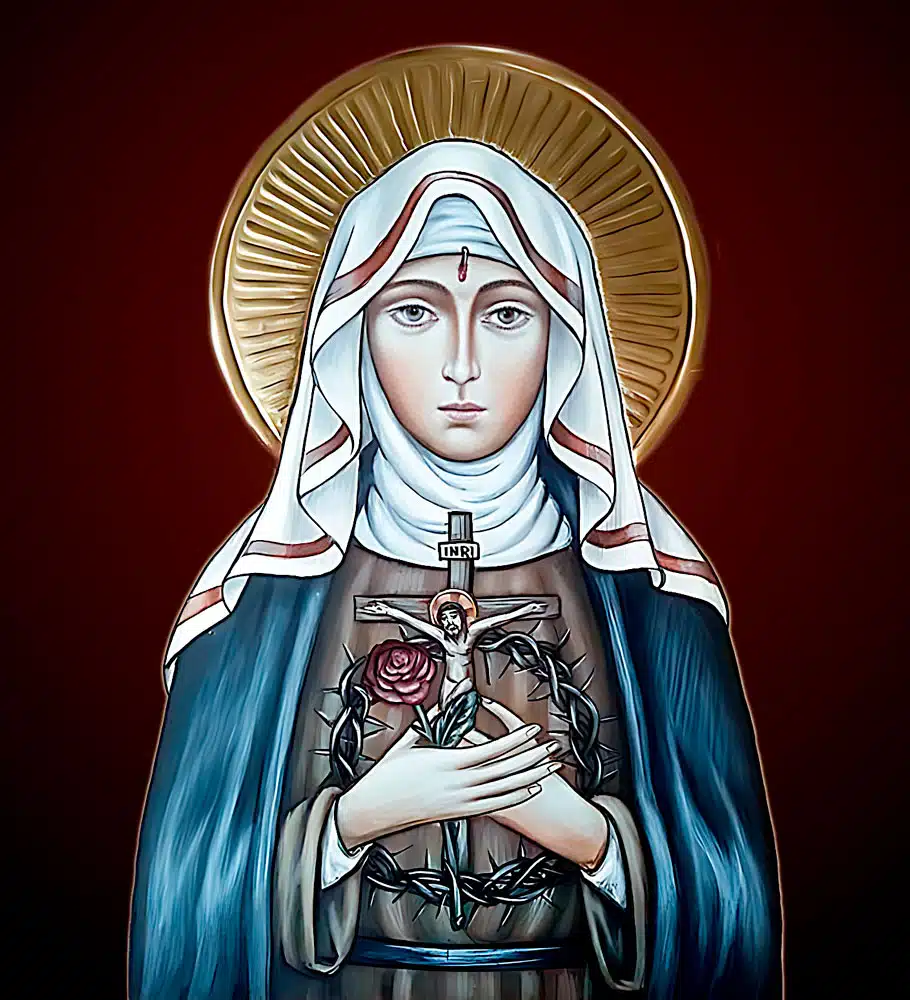
Its most representative symbols are: roses, figs and poppies. Usually, in the iconography, she wears a white tunic and headdress, with a black cloak and an over-tunic, fitted with a golden belt that reaches down to her feet. On the ground, on the sides, commonly, you can see two vases with roses.
What is in your hands?
In his left hand he usually holds a crucifix; in the right hand he can carry disciplines or elements for self-flagellation. He is also identified holding one or several roses in his hands.
The stigma of Santa Rita
Tradition has it that, in 1428, during an intense prayer, in the early hours of the morning Rita received a splinter of wood from the hands of Christ that would be stuck in the bone of her forehead. This phenomenon is known as a divine stigma. It is about the mark of the crown of thorns that Jesus Christ had carried during his passion and death. Next, the splinter that was kept as a sacred relic was extracted from her. From that moment on, every morning her stigma reopened on its own, until it reached the point where it began to sprout from it, a putrefied odor that remained for the rest of her life.

By 1453, Rita became seriously ill, until she fell into bed. The wound on her forehead gradually closed, however, for the next four years the nun suffered various conditions caused by blood infections, dying in 1457. It is said that, at the time of her death, the sore shone on her face Like a star in a rose bush.
Prayer to Santa Rita in difficult times

"Oh merciful God! Lord of heaven, protection of the afflicted, before you come those who wait. I implore you to listen to my pleas. I cry out for the mercy of all the saints and especially for the intercession of Santa Rita de Casia, faithful devotee of yours and example of faith, love and respect for your holy will.
Oh merciful Santa! I adhere to your intervention, so that your heavenly light illuminates my paths and allows me to live under the precepts of God, being a genuine Christian, focused on the correction of my sins in order to achieve the grace of the Lord and the forgiveness of my faults.
Oh blessed Santa Rita! You who in this Land of suffering and anguish met so many difficulties. You know very well what it feels like to suffer under the unfair hand of mistreatment, and at the same time, keep intact the virtues inspired by the Creator. I ask you to be my inspiration to house within my heart the nobility, love, and charity towards my neighbor and myself. You, Saint of lost causes, fill me with the strength to be able to wait for the blessedness promised by Our Lord Jesus Christ.
Oh dear Santa Rita de Casia! You, who know what it feels like to suffer contempt, mistreatment, and even violence in your own home, do not allow him to suffer any humiliation, neither inside nor outside my house. That my opponents cannot harm me in any way, and that their machinations incited by the devil cannot affect the development of my affairs.
Oh benevolent Santa Rita! You who are love, devotion and faith, sow in my heart the seed of your virtues to reap in my actions the teachings of the Lord.
Oh merciful Santa Rita! You, who are a reflection of fidelity and patience, endured the strongest pains in the name of faith, because, without hesitation, you asked to share the suffering of the sacrifice of the Son of God for all of us, you are an example of love for God and neighbor.
Oh compassionate Santa Rita! You who with so much charity give bread to the needy to feed their body and soul, teach us to live a sincere conversion from the depths of our soul.
Oh powerful! You who are the lawyer of desperate cases, of impossible causes, be our help, hope, refuge, defense and solution to the pain that overwhelms us. Don't let us drown in the seas of despair. Protect us with all that temperance that characterizes you, which nourished with heavenly trust leads you to the throne of God to ask for the most unfortunate.
Oh Santa Rita! Always lend these to help your brothers on this Earth, do not deny me your gaze and the compassion of your heart, because tribulation has knocked on my door and my strength fails in the face of worry.
You well know what is inside my heart and my soul. With humility I stand before you exposing all that I am, because, although I confess myself to be a sinner, my greatest desire is to amend my mistakes to please the Father who loves us and has given everything for us. That's why I beg then, come to my aid Santa Rita de Cascia.
I beg you Santa Rita of my devotion that, even though my cause is difficult, you intercede before God Our Lord so that my needs are attended to and my agony healed (make a request). Likewise, I also raise my prayer on behalf of all those who suffer, and who await a miracle to resolve their problems.
Blessed Santa Rita, I implore your greatest help, so that your word, your prayer, your intercession may accompany my pleas and be brought to the feet of God, Father of mercy and source of all comfort. In your hands I surrender my cause, waiting with faith that the grace that I long for be granted to me. With certainty I am sure that you will help me, and I will use your mercy to cleanse my soul, and improve my life and my habits, revitalize my faith, and fill me with the strength that will help me to count on all the Earth and in the sky on the divine goodness and mercies.
Oh blessed lawyer of the impossible, Santa Rita de Casia! I attach myself to your goodness, I trust you, therefore, you are a light of patience that encourages us, you quench the impetus of demons, you shelter the helpless, and you are a guide to the true Christian life. Listen to my prayers and accompany me with your blessing. May the perpetual light of the Creator shine for you. Amen".
Pray an Our Father, a Hail Mary and a Glory Be.