
Treaty of Ika and its Omoluos
We bring you all the information about IKA such as its 16 Omoluo combinations, this treatise covers from Baba Ika Meji to the omoluo Ika Fun.
Sayings, Patakies, Ebo, what is born, recommendations and variants of each Odu or Sign of Ifa. Oshaeifa.com brings you the treatise you are looking for to expand your knowledge of literature and the Ifa Corpus.

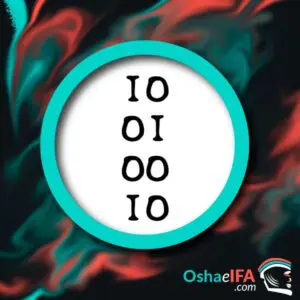


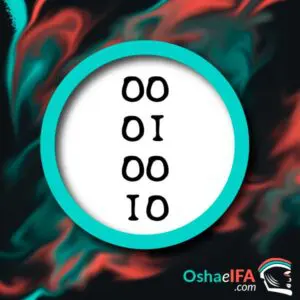


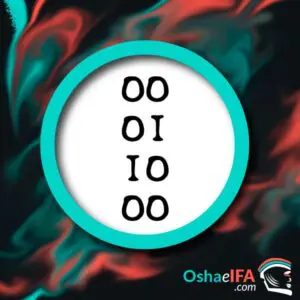


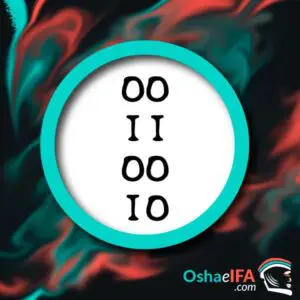
Ika Meji's real name in Heaven.
Ika Meji's name in Heaven was IKERE IYANSI. He was a very powerful Awó in Heaven who had many followers under his command. Among such followers were Ekpo keun and Eninuo keun, who guessed for Utukpa, in other words it was the little oil and the little thread that made divination for the lamp when he was going to have the reward of a human being, They told the lamp to make sacrifice with a rooster and a hen and he did it, then they gave him a human as a slave to serve him forever. This is the reason why to this day, it is precisely a human being who refuels or re-lights a lamp when its fire is dying out.
When the lamp is about to go out, people call on a boy or girl to turn it on again. If there is no one in the vicinity, the person does everything himself in service of the lamp.
As important as they are: food, air, and peace for the body, they act on their own; whereas it is only the lamp that is often aided by human beings.
That is the reason why when Ika Meji comes out in divination the person is told to make similar sacrifice, if he is a man he will be told that a woman comes to marry him of her own free will, who will serve him with obedience and loyalty to the end of his days; if she is a woman, she will be told to find a new husband
that he will serve him as a slave and that he will not think of marrying any other woman after her.
Ika guessed for the cat.
One of the substitutes for Ika Meji called Iba rere, was the Ifá priest who guessed for ono (fire), another Ikelewii priest guessed for the cat when he came to the world to hunt. They told him to make sacrifice with a knife and scissors (awan in Benin and eemu in Yoruba), and add a rooster and a dove.
He was required to make the sacrifice so that no victim that he caught with his claws would escape.
After doing so, he came into the world. Then he developed a strategy for their hunt. Out of respect for the sacrifice he made, the fire became the line of light in his eyes, as soon as the cat sees his victim, he stands and directs the bright light from his eyes to dazzle the victim and says mootishebo ikelewi, It falls on him and catches him, this is how the cat hunts to this day.
In divination the person should be told to make a sacrifice for whatever he aspires to achieve and can bear fruit.
Ika Meyi prepares to come into the world:
Originally he was a very young disciple (Odu) of Orúnmila. Normally he sat among the disciples and not with the fifteen Apostles (Olodus). When he was preparing to come to the world, he went to an Ifá priest named Ukere, gbagburu, wamu-awó oji. He advised him to make sacrifice with a goat to Eshu-Elegba and with a ram to Ifá. Afterwards, Eshu-Elegba went to Orúnmila and told him that Ikere Iyansi (Ika Meji) was quite skilled and experienced to be Olodu. This is how he became one of the sixteen Olodus.
What Eshu-Elegba did was tell Orishanlá that the gray-haired Odus were inferior to Ika Meji and Orishanlá sanctioned him, told him to leave Odus's group and join the Olodus.
Finally, before leaving Heaven he went to see two Awoses for divination named Awi are, Ese ori ejo and Ure ejo onajawa. They advised him to give another he-goat to Eshu-Elegba, a guinea to his Ifa and a dove to his head to avoid the danger of encountering insurmountable problems on Earth.
He made sacrifice and went out into the world as an Olodu. Upon arrival he discovered that because of his inferiority in the apostolic genealogy of the Ifá literary corpus, he was often looked down upon by the remaining Olodus, who attached little or no importance to everything he did. He also had trouble living on his own income, he had no wife or children.
Meanwhile, Eshu Elegba created new problems for Olodumare by disrupting his creative art and designs. As Olodumare (God) was used to doing he decided to go disguise himself and find out what was causing his problems. The first Awó he encountered was Ika Meyi.
Before guessing for him and without knowing that this was the Almighty Father, Ika Meji asked for a bag of money or the equivalent of 50 cowries as fees for divination, and told the inquirer that Eshu Elegba was responsible for breaking his work, and that he had to offer a male goat as a sacrifice.
Olodumare replied that he did not raise the money to buy a he-goat.
Ika Meji took out a he-goat from his house and used it to serve Eshu-Elegba for the supposed "helpless indicator", whom he could not recognize as Olodumare. He simply did her the favor out of humanity and compassion. Then the searcher thanked Ika Meji and asked him where the residence of the remaining Awoses was. He showed her the address of Ejiogbe's house. The visitor left for the house of Ejiogbe in search of divination.
Upon arrival, his response to Olodumare's request was that he did not have time to guess at that moment.
With that slight, Olodumare turned and returned to Heaven. Before coming home, Eshu-Elegba had abandoned his designs and things had returned to normal, because he had fed him. Three days later he dressed up as the Almighty Father and went back to Earth. When Ika Meji saw him, he shuddered and trembled, he told him not to be scared because he had come to reward the cost of the sacrifice that he had made three times ago.
After rewarding him for the goat, Olodumare ordered him that from then on no one would challenge what Ika Meji said. This is how he received his instrument of authority (ashé) from Olodumare, which prohibits any priest of Ifá or Deities, from withholding anything he proclaims.
Olodumare also told him that he would have all the prosperity he desired while on Earth.
After this, he had abundant money, wives, and children.