
Treaty of Ojuani (Owonrin) and its Omoluos
You are looking for information about the signs of Ifa that begin with Odu Ojuani, here we have everything you need, the encyclopedic treatise of Ifa from Oshaeifa.com contains all 256 including the 16 corresponding to the book of Ojuani (Owonrin).
Encyclopedic treatise of Ifa Book of Ojuani.
We bring you all the information of Ojuani (Irosun) as the one of its 16 Omoluos combinations, this treatise covers from Baba Ojuani Meji to Ojuani Bofun.
Sayings, Patakies, Ebo, what is born, recommendations and variants of each Odu or Sign of Ifa. Oshaeifa.com brings you the treatise you are looking for to expand your knowledge of literature and the Ifa Corpus.




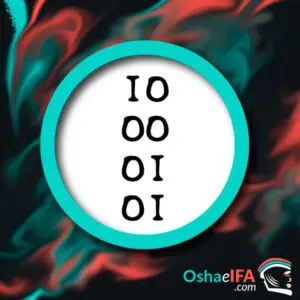

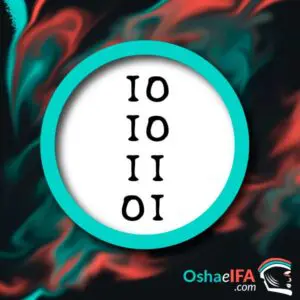


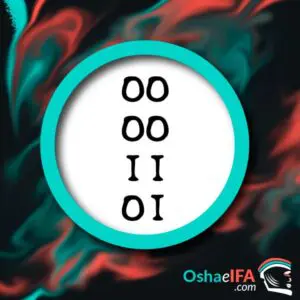


OJUANI MEJI guessed for two brothers FEFE and ALE.
The most important work that OJUANI MEJI did in Heaven was the divination that he performed for two brothers, FEFE and ALE (the Wind and the Ground), when they came to the World. He advised them to make sacrifice so that they would command the respect of each and every one on Earth. They were both told to sacrifice with a palm leaf, a parrot feather, and a sheep to their guardian angels, and to give one goat each to Eshu.
ALE was very calm, patient, and a very good listener. He quickly made the sacrifices. FEFE was, on the other hand, fast, rogue and full of alacrity. He was so conceited that he did not consider it necessary to make any sacrifices. They both left for Earth at the same time. Upon reaching the boundary between Heaven and Earth, they took
by different paths.
ALE was very successful on Earth, where it became the anchor of salvation for God's living creatures. They had been told in Heaven that they would live forever if they made the sacrifices. Since ALE was the only one who made the sacrifice, it turned out that every plant or animal that came into the world had to
Offer your respect by touching the ground with your head.
FEFE, on the other hand, was unable to live a quiet life on Earth. His abode was ephemeral because he dedicated himself to going back and forth between Heaven and Earth. This is the reason why the soil has a stable and permanent existence on Earth, while the wind is not only invisible but has no existence.
known. His presence can only be felt, it cannot be seen.
OJUANI MEJI PREPARES TO COME TO THE WORLD.
Seeing that most of his older brothers were gone, he too decided that it was time to come and see what Earth was like. Those who had come before him had given a report on the state of affairs on Earth. He was so afraid of the bad luck stories told by others that he decided that before coming to Earth he had to strengthen himself.
He approached an Ifá priest in Heaven, named OSHUKPA OMO ALASHO ARANKIJE, who did divination for him. He was advised to sacrifice 3 rats, 3 fish, 3 goats, 3 male goats, 3 roosters and two dogs, as follows: 2 male goats to Eshu OBADARA.
1 male goat to Eshu JELU.
1 goat to ORISA.
1 goat to Ifá.
1 goat for SARAH.
1 dog for OGUN.
1 dog for OBALIFON.
1 rooster to UJA ATIKIRIJI.
1 rooster to OSANYIN.
1 rooster to ENEMY.
He was told that he would pass three tests during his time on Earth and that these sacrifices were necessary in order to survive them. He was told that he would lead a prosperous life, but that Death would always be on his trail with a club. Likewise, on the chart of his life was the risk of a very long illness and incapacitation. At the end of the two trials there would be the welcome air of prosperity and wealth. He made all the sacrifices.
Due to the elaborate sacrifice he made to Eshu, he began to see the good effects of it even before he left for Earth. As soon as Eshu ate his goat, he removed the skull of the dog given to OGUN and placed it at the entrance to the House of the King of Death. Meanwhile, OGUN was looking for the skull of the dog that he had eaten and thus he reached the house of the King of Death, who at that time had gone out to fulfill his daily tasks on Earth, in search of food.
OGUN eventually saw the King of Death somewhere on Earth and captured him. Needless to say, OGUN is stronger and meaner than Death. OGUN accused Death of theft and ingratitude, claiming that he was dissatisfied with the human flesh that he brought to him as a result of accidents every day and that he had also started to lust after his favorite food (OGUN's), the dog.
Death, knowing himself to be helpless in a combat with OGUN, disappeared as he usually does. OGUN, on the other hand, does not have the ability to disappear. However, he quickly ran back to Heaven, to meet Death in his house.
When OGUN encountered Death in his home, he began attacking him with his machete. Death, who is a tall and thick divinity, finding that the punishment was too much for him, screamed for all the dogs of Heaven to be gathered. His followers collected 201 dogs and immediately roasted seven of them for OGUN, who had meanwhile destroyed many lives and property in Heaven.
When OGUN was punishing Death, his wife, the divinity DISEASE, received injuries in the stampede and was unable to follow OJUANI MEJI to Earth, as planned. It was during the rage in Heaven that OJUANI MEJI escaped from there and began his journey to Earth.
When the dust settled and OGUN had left Death alone, ARIKU and AJE (Long Life and Prosperity) were able to accompany OJUANI MEJI to the world. It is significant to observe how the elaborate sacrifices made by OJUANI MEJI began to manifest themselves, distracting attention from the obstacles that would have bothered him on Earth. That is why the children and followers of OJUANI MEJI are endowed with wealth, long life and prosperity, provided they are able to make the same sacrifice that he made before leaving Heaven for Earth.
OJUANI MEJI TIES THE HANDS OF HIS ENEMIES.
Just before leaving Heaven, he met other Ifá priests, called:
ORONKPON TOLO TOLO
IRI ARIMO NIRIN BIRI BIRI BIRI
EYE KPA AGBALAGBA NINU OKO
ODE LE EERAHO MU BURA
They advised him to make a sacrifice to avoid being the victim of a conspiracy when he was in the
Land. He was to give another goat to Eshu, on the very eve of his departure. After this, he made a meal with a gray goat for the oldest Awos in Heaven and they all gave him their blessings, promising him eternal support while he was on Earth.
Finally, he went to see God, seeking blessing and authorization, carrying a piece of white cloth, a large piece of plaster, a parrot feather, and two white kola nuts. God received the offerings and conveyed his good wishes, thus formally authorizing him to go to Earth.
He left the town of OYO and dedicated himself to his art as an Ifá priest, while also trading. At first he was successful in both vocations, but his early prosperity began to provoke envy in the older Ifá priests.
Very soon, they began to collude against him. They made a collective guess about what they had to do to reduce the popularity of OJUANI MEJI. Finally they decided to go see him in search of divination about what had to be done to destroy him. He told them to make sacrifice with
a goat to his Ifá and a male goat to Eshu. Meanwhile, Eshu alerted him that sacrifice was being made against him and he replied to Eshu that he had already seen it during the divination he had made for them and that he already knew what he had to do to checkmate their machinations. . They did not return for the sacrifices.
Meanwhile, it was time for the annual festival of one of the deities in the village. The conspirators invited OJUANI MEJI to accompany them to the ceremonies. They had dug a hole in the floor on the way to the site of the ceremony, that is, the sanctuary of the deity. They expected him to take that path, while they would go a different one. It was customary for visitors to the shrine to come and go by different paths.
After the conspiracy had unfolded before him, OJUANI MEJI told them that he was prohibited from visiting any sanctuary other than ORUNMILA, but they responded by threatening to expel him from the town if he did not attend the ceremony, because that was an obligation. civic of all
inhabitants of OYO.
Thus threatened, he decided to consult Ifa about what he had to do and his Ifa asked him to make a sacrifice with a gray goat for him and a male goat for Eshu. He made the sacrifices, after which he set out on his journey to the sanctuary, where all the visitors had to stay for fourteen days. It was customary for them to arrive there in groups, but to return home separately.
On the fourteenth day, all the ceremonies came to an end and it was time to part. The conspirators told OJUANI MEJI that, being a neophyte, he should be the first to go home. This was how they hoped to tempt him into the hole they had camouflaged on the way.
When he approached the place where the hole was hidden, Eshu transformed the skull of the goat with which he had sacrificed into an obstacle on the ground. OJUANI MEJI bumped his foot against the obstacle set up by Eshu, jumped over the hole and safely continued his journey towards the house. People celebrated with him when he came home healthy.
Meanwhile, Eshu plugged the hole dug by the conspirators and prepared another, just outside the main door of the sanctuary. Long after OJUANI MEJI had left, the conspirators decided to leave one by one.
They had no reason to suspect the presence of another hole just outside the sanctuary. Eshu had installed the goat's skull as an obstacle, very close to the hole. The first conspirator struck his foot against the obstacle installed by Eshu and fell into the hole. Eshu then prepared the obstacle and the hole for the next conspirator, until all of them were found safe in the bottomless grave dug by Eshu.
Once the last conspirator was in the hole, Eshu sealed it off as if nothing had happened there. Thus, the conspirators disappeared from sight, without the slightest hint of what had happened to them. From that day on, ORUNMILA ordered that whoever goes in search of salvation to a sanctuary, must do so with a clean heart because the wicked may not return alive.
Soon after, there was an uproar in OYO as many families began searching for their lost husbands, children and relatives. The people decided to go in search of divination en masse. Again they went to look for OJUANI MEJI, who after divination, revealed that the King of Death had sent messengers to kidnap all those who returned from the sanctuary and who had evil intentions.
He revealed to them that it was because of that vision that he had told them that before leaving for the sanctuary they should offer a goat to his Ifá, to appease the King of Death, and a he-goat to Eshu to ward off danger, but they they did not return to perform the sacrifice. He also advised them that the sacrifice had yet to be made in order to buy the lives of those who by now were too frightened to leave the sanctuary.
The sacrifices were made swiftly and it was only then that Eshu cleared the way for the remaining worshipers in the shrine, who wanted to return safely to their homes.
When the blizzard passed, OJUANI MEJI made a great meal, where he celebrated with a song in praise of the priests who divined for him in Heaven. A) Yes:
The elders of OYO were told to make sacrifice,
But they ignored it.
I was told to make a similar sacrifice,
I listened and made the sacrifice.
I stumbled and survived
Because I made the sacrifice.
Others stumbled and died,
Because they didn't make a sacrifice.
Those who make sacrifice
They infallibly receive salvation.
OJUANI MEJI'S EXPERIENCE AS A TRADER.
His first test as an Ifá priest impressed him so much that he thought about leaving the practice and dedicating himself to a less contradictory vocation. He was surprised by the enmity engendered by the success and achievements achieved through the art and practice of Ifá, and decided to limit his activities to trade with the following poem:
GBI KODO LEGUNMAJA
GBA AGHEN MU BO RI
UMA SHO LUGOBODO
JOGUN FAITH MAYA
HA AYO JERE TUMODON
He was trading with the divinity of water, but as he had not made the proper preparations before embarking, his efforts failed disastrously and he lost all his money, leaving him deeply in debt. He then approached the parrot for help, but the parrot told him that he, too, was in debt up to his neck. The parrot proposed that, since no one ever agreed to give financial aid to the debtors, they should both begin to practice the art of Ifá. They decided to leave OYO and go to another town where they were not known.
OJUANI MEJI had a good luck soap that did not help him in his trading activities. However, when given to others to use, it was completely effective and those who used it returned to express their gratitude, with abundant gifts. Their association with the parrot produced good results and together they were able to help various people and prosper in their business activities. This is why it is said that a doctor can heal others but not himself.