
Treatise or Book of the Oddun of Ifa ODI and its Omoluos
We bring you all the information about Odi such as that of its 16 Omoluos combinations, this treatise covers from Odi meji to Odi Fumbo.
Sayings, Patakies, Ebo, what is born, recommendations and variants of each Odu or Sign of Ifa. Oshaeifa.com brings you the treatise you are looking for to expand your knowledge of literature and the Ifa Corpus.


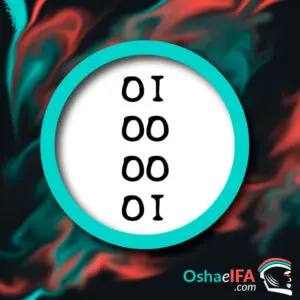
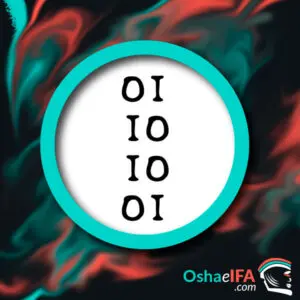
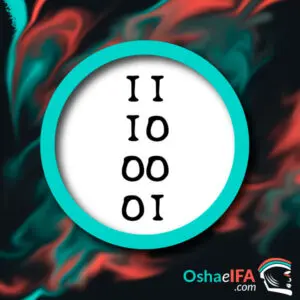
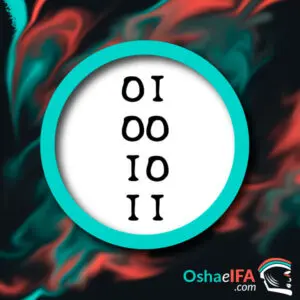


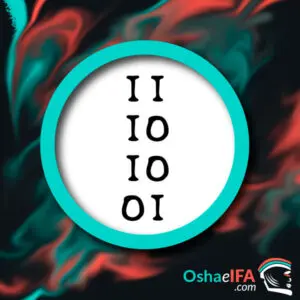
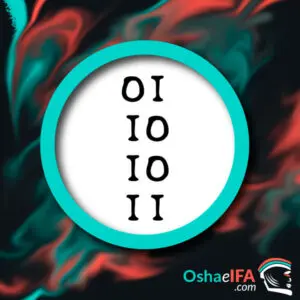
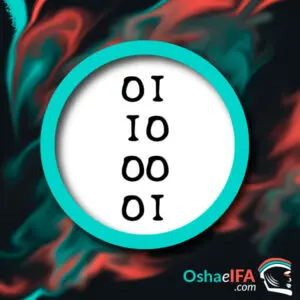

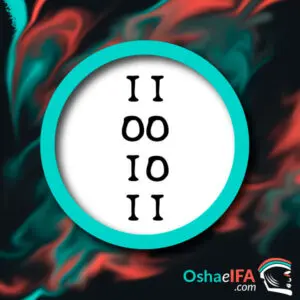


The birth of ODI MEJI.
ODI MEJI was so conceited that he never bothered to consult himself before setting out on a trip. On the one hand, because he did not see the need to consult with Divinities or Priests of Ifá whom he considered inferior; on the other hand because he was convinced that with his strength and his knowledge, he would succeed in any test. When he decided it was time to go to Earth, he set out on the journey carrying only his two instruments of power and authority: The Lightning Stone (ODU-ARA) and the smelting furnace. These instruments were used by the Deity of thunder (SHANGO), and the one of metals (OGUN) carried the two instruments inside his head.
You may also like: All the information about the Orisha Shango here.
When his followers saw that he was leaving for Earth without any prior preparation, they met him and reminded him that he had never chosen his own wife while he was in Heaven and that therefore, he thought that he could not go to Earth without having chosen one to accompany him in life; unless he made an offering of a goat to ESHU and a guinea to his Guardian Angel first. Another argued that if there had been no one in Heaven to subdue him, how was he going to do it on Earth. Baba Odi Meji said that he intended to celebrate on Earth in the same way that he used to celebrate in Heaven. He was reminded of the disturbing influences he had suffered from the Deities whom he had disturbed in Heaven and pointed out that on Earth he would have less power to subdue them, since they had come down first than he did.
Among the servers that gave him all these warnings were:
«ABIMI LORIGI-OMO IYI NI MI
EDO OKPE NI MOJE
EDO OKE NI MO MU
OKURO NI OGBIGBO. »
On Earth he had a father who was a priest of OGUN and a mother priestess of SHANGO.
He came out of the womb with the lightning stone and the smelting furnace that he couldn't use until he was big. At ten years old, he was already fighting with the older adolescents; even, nobody could ever make him bite the dust. He became so fierce that everyone feared him, they nicknamed him The Invincible Man. Meanwhile, he would go from time to time to the secret place where he kept the weapons he had brought from Heaven.
One day he saw his father preparing to beg for his head with a dog, took the father to the place where he had the oven and sacrificed the dog there. When the people saw him, they reproached him for his action, but he told them to go to the place where the animal had been slaughtered and to check, because what was there was a goat and not a dog. The dog had been transfigured into a goat, which he brought to his father so that he could beg for his head.
On a second occasion, her mother was preparing to serve her head with a sheep, when she told her that it was forbidden to use that animal in that type of offering. He took the sheep to the place where he had his lightning stone and sacrificed it there. For the second time he was criticized by the other old men of the place, who he told them to go see if there was palm oil and a rooster there. The people gathered the palm oil and the rooster, and took them away to make their offering, instructing him to drink the oil. He then confessed to his parents that he had come from Heaven to remind them of their patron Deities, OGUN and SHANGO, whom
they had ignored for so long. He gave the smelting furnace to his father to make iron objects and the lightning stone to his mother to use as an attribute and priestess of SHANGO. He taught his father how to serve OGUN and his mother how to serve SHANGO.
This rediscovery of the paths of their destiny immediately transformed them into a famous and prosperous couple. It was ODI MEJI who taught the world how to honor OGUN and SHANGO; in fact, it is believed that he was the first Odu to introduce human service to these Divinities. Subsequently, he left his parents' home and went out into the world. Nowhere could anyone subdue him, he was so feared that no woman wanted to marry him, nor did any man live by his side.
When he found out that he had been condemned, he left all the cities and towns and built a shelter deep in the forest, as soon as he went to live there, his image as that of a bad person spread. In his new home he planted kolá, walnut and pear trees, the plants grew soon and began to bear fruit, one night his Guardian Angel visited him and told him in dreams that he was suffering from so many deprivations because he had stopped honoring while He lived in Heaven, and although he added that it was too late for that, because of how old he was, he still had to make the offerings. As he did not know who had spoken to him, the next morning he decided to consult his Ifá and his own Odu Patron appeared to him. Hate. He realized that it had been his Guardian Angel who had spoken to him during the night. With the sale of the fruits, he had to buy a goat to give to ESHU and a guinea for his Ifá. In the end he consented to
make the sacrifice.
Once the offering was made, he played his Ifa again who told him that something bad was going to happen in the nearby town and that he would have to play a role there
decisive. Meanwhile, the king's eldest daughter was having a difficult delivery.
All the priests of Ifá and the priestesses of other Deities had tried and failed in the attempt to aid in the delivery. When there was no one left to turn to. ESHU entered the head of one of the king's advisers, who immediately remembered Odi Meji could give a hand in that matter. They invited him right away and Odi brought her divination bag and took out some leaves, prepared them and put sacred powder on them, then she repeated the following incantation that Ifa priests use when a woman is giving birth in difficult circumstances.
Enchantment.
AWO LAAFI RABE TAAFI DAE LOKO GBAA
EDON TO MOJU GANRANWUN
OKUKO TAAKPE OKO
ILA ABENUKPA KAA
ORUKO TAAKPE OBO
ALARISA NOTIGBE OMO OLOMODE SINU
ETU OMO OLOMO BOGBORO ORITE EJE WAYE. (repeats everything 3 times).
While he was repeating the enchantment formula, he washed the woman's abdomen with the leaves and then gave her the preparation to drink. He had not finished reciting the verses when the child and the placenta came out together. It will be remembered that it was ODI MEJI in Heaven who made it possible for a woman's penis and pelvis to produce children.
On Earth, he simply reminded the vagina that she was only designated as a step to take a child out of the womb. The whole essence of the enchantment is to remind people of their heavenly name and role on Earth, and after this it can be conjured to behave as desired.
As soon as the woman was able to give birth, all the heads of the palace began to praise the great powers of this man who was known as a lunatic. His courage was finally recognized but only after he had consented to make the sacrifices. To reward him, the king gave him money, a man and a woman, as he was too old to mate, told the man and woman to live with him as husband and wife for the rest of their lives.
Once his value was recognized, people began to frequent his house to consult him on all kinds of problems, and he helped them. The king
eventually he conferred a title on him and recommended that he move his house to the town. In the sanctification ceremony of his new home he performed songs and prayers to his Ifá priest in Heaven, in which he regretted not having followed his advice. He advised others to make sacrifice if
they wanted to avoid the sufferings of an adverse fate, since he had planted trees whose harvest would be reaped by others, since he had left no one on Earth to be his heir. It is known that Odi Meji after that, and before reaching Heaven, did not take many missions.
Story of Odi Meji in Heaven
It is recognized that ODI MEJI is one of the strongest Olodús in the Ifá family, it is very aggressive and bellicose. When he was in Heaven he was known more for his bellicosity than for his priesthood, however, he is undoubtedly an efficient Ifá priest. Because of his numerous activities outside the celestial realm, he does not perform many Ifa practices; instead, that part of the work is usually done through third parties: for example: When Ode (the outsider or outsider) came by divination after suffering a reversal of fortune, it was one of ODI MEJI's assistants who helped him.
Odi Meji guesses about the man's sperm and the woman's menstruation.
It should be remembered that at the beginning of time, plants and animals did not procreate in the way that is known today. If we go back to the
origins of man and woman, we see how they only lived together, because they did not know how to procreate.
Previously, Eshu recomposed the woman's pelvis from forehead to crotch, but the woman didn't know what to do with her pelvis and the man didn't know what his penis meant either. Sperm and menstruation having separate identities were guessed at ODI's home, where they met his servants named:
OGAN OFORI SO SIKI
OFFESE SO YEGBE
OFI AKBEDE GBEDE MEJI SON LEBE
IBO EFUN OBALE FROM RUMU RUMU
AWON LOO DIFA FUN ATO
ABUFUN ASE.
Sperm and menstruation were both anxious to know how to procreate. OLORDUMARE had created them and left them to use their own intelligence and find a way to procreate; The two were advised to slaughter a goat. The sperm was told to add husk, a white rooster, a white robe, a white dove, and okra. Menstruation had to put a red rooster and red wood at their own sacrifice. They provided all the materials for the sacrifice and the Ifá priests used them to prepare a medicine that they had to ingest.
The sperm was then told to go away and live with the man, while at menstruation it was advised to visit the woman and stay with her for five days out of thirty. This is how we became the children of sperm and menstruation, through man and woman.