
Oduduwa: The greatest Orisha of the Yoruba pantheon
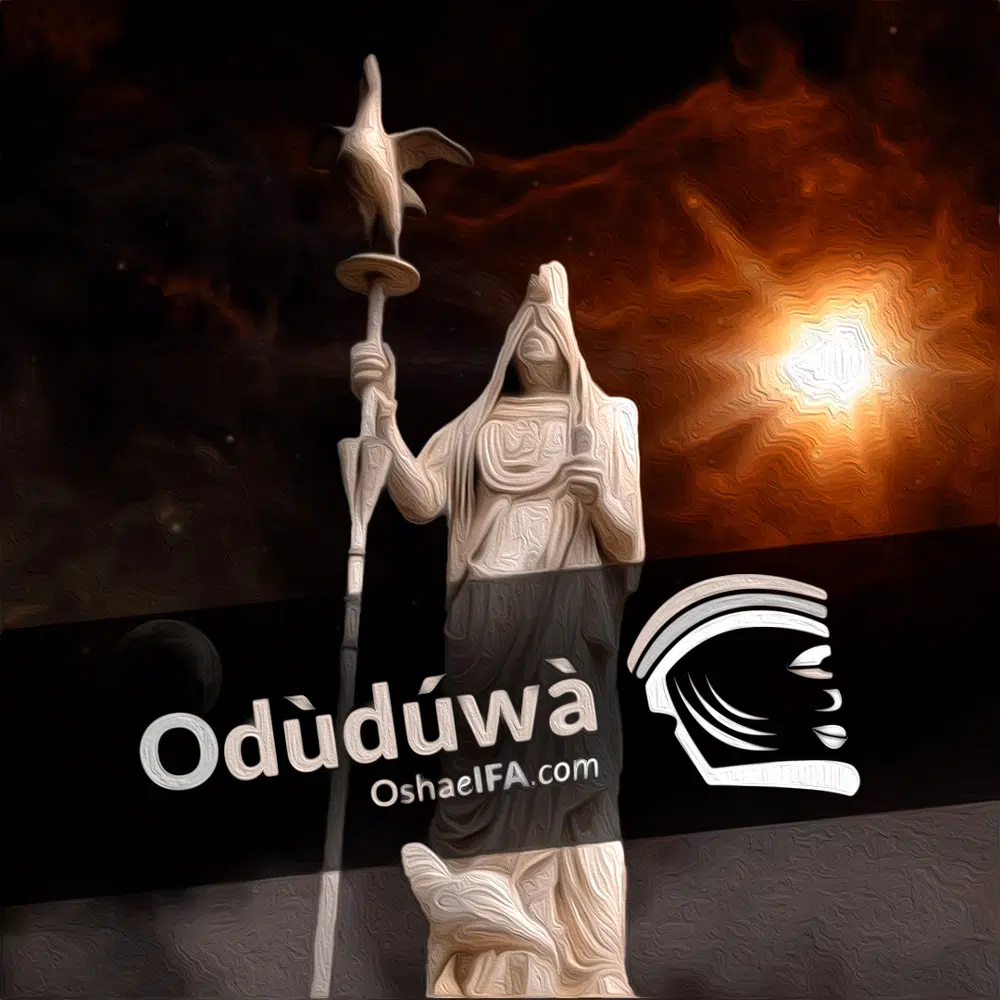
Oduduwa is the Orisha representative of the mysteries and secrets of the kingdom of death. Builder of the world in the company of Obatala. Knowledgeable of the mysteries that our destiny contains as we are Orunmila's inseparable companion. His word is always law and sentence.
Who is Oduduwa?
Odùdúwà is a major Orisha, also known under the names: Odudúa, Odúa, Oòduà, Odduduwa or Oddúa, it is one of the main spiritualities of the Yoruba culture. His name is interpreted as: “leader / the other world”, therefore, he could be defined as “Lord of the other world or our destiny”

Oduduwa is a very interesting figure for the practice of the Osha and Ifa rule. He is held responsible for shaping the modern leadership of the Yoruba nation. During his tenure he was known multiple wives such as: Olokun Seniade, Osara and Ojummo-Yanda, with whom he left several descendants.
In his incarnate transit in the world, Oddúa served as the first Obá that Itá made on earth and the first Oní (King) of Ife. Now, regarding its spiritual representation, it is attributed a great participation in the creation of the world, as well as in the conception of the animal, vegetable and mineral kingdoms.
It is said that it lives in the darkness and gloom of the night, that it has a single fluorescent eye, since it is an energetic mass of great power and therefore, it has no shape or figure. Its way of manifesting is through the spirits.
Oduduwa: The Orisha with the most Hierarchy in Santería
This Orisha enjoys a high hierarchy in the Yoruba religion. His relationship with the underworld goes beyond showing the imminence and supremacy of death. Rather, their work is about making it apparent to human eyes how fleeting life can be. Being him, a worthy representative of the implications that death can bring and the eternity that it entails.
In addition, Oddúa symbolizes the capacity and understanding possessed by those who have transcended the known in the physical world, reaching a harmonious and sublime balance of the spiritual world. That is why he is considered the foreman of all the spiritualities that inhabit that dimension.
Characteristics of this Orisha
Between her CARACTERISTICS It stands out that it is an Orisha who governs the mysteries of the Egun and Ikú. Primal representative of ancestor worship. With an incalculable antiquity, let us remember that his participation in the creation of the cosmos is attributed to him. Its energetic power is such that it has the ability to present itself through other entities.
Odudua's number
His number is 8 or 16 and all its multiples.
Receptacle: Chest of Oduduwa
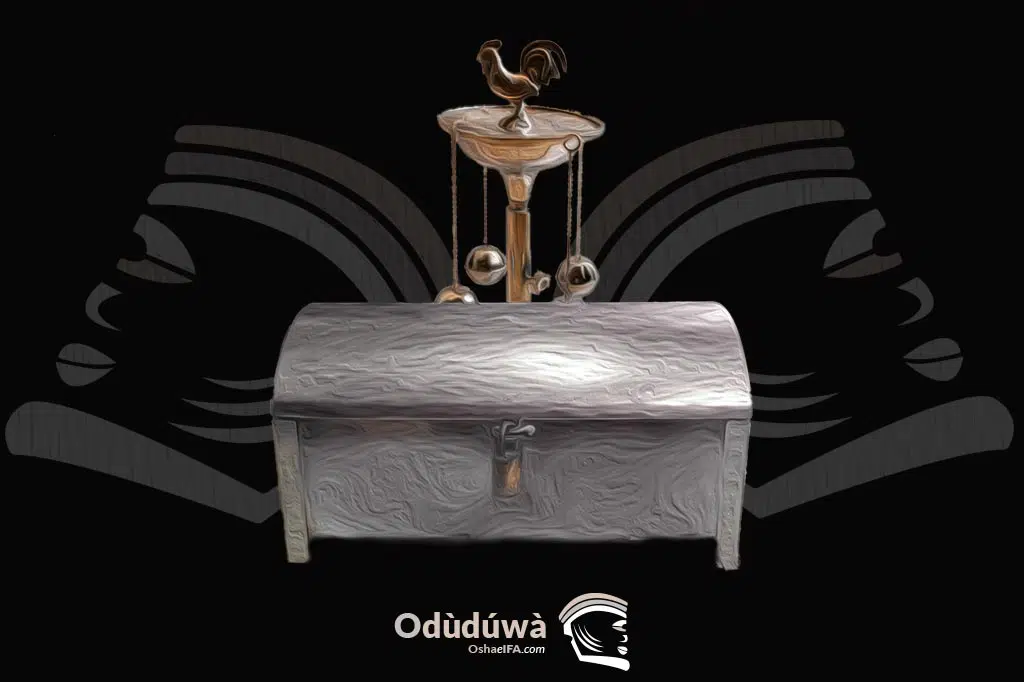
It is a chest made of wood or metal. Known as "the chest of secrets." It is usually kept tightly closed after its foundation. His manipulation is of great delicacy as he is considered an Orisha who should not be disturbed for insignificant reasons.
Oduduwa attributes and tools
- Wooden skull.
- An aye.
- A wooden eya.
- A jar for Bromú.
- A jar for Brosia.
- Aboni's little house.
- Odua atemoleta.
- Set of tools made in silver preferably.
Colours
Its color is white, a symbol of purity and the high spiritual level that this Deity possesses. Although their paths can be combined with different colors.
Oduduwa Necklaces
Their necklaces or elekes are usually made with white, soap, transparent, or beige colored beads. You can also add ivory, mother-of-pearl and red corals. According to certain paths, black, red, orange and green beads can be placed on it.
History of the Orisha Oduduwa
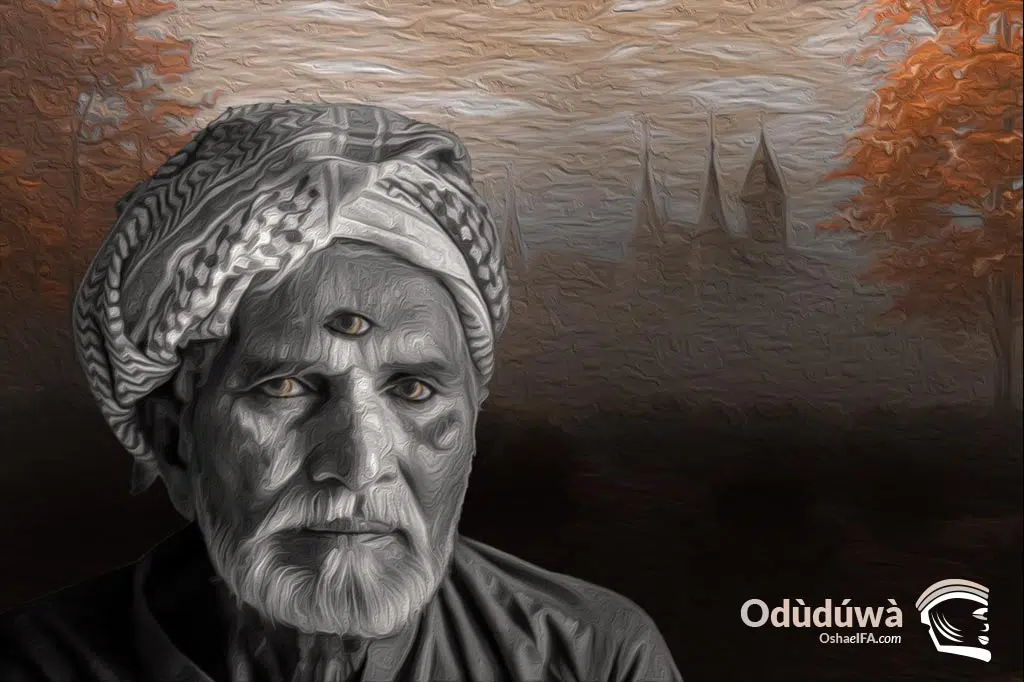
Geographically the history of Odudúwa begins in Benin, Nigeria, West Africa. In his physical incarnation Oduduwa was known as a prince by the name of "Ekaladerhan." It is said that he was banished by his father named Owodo, the last Ogiso (king) of Benin.
His banishment was due to the manipulated predictions of the oracle and Owodo's wives, recommending that his father should murder him, otherwise, his wives would not give birth to more children. However, his father's love did not allow him to execute that request and he preferred to send him away from those lands.
When Ekaladerhan left, he did so with several of his followers. His departure filled the people with deep sadness. After all, the injustice to which the prince was a victim was orchestrated by those closest to the King.
Arrival of prince Oddua to the lands of ile ife
Legend has it that when Ekaladerhan arrived in Ilé-Ifé, he continually pronounced the word “Iduduwa”. Over time it became known that this word comes from the Bini language which translates as: "sadness, grief, regret" and on the other hand means "I found fortune." Subsequently, the people of Ilé-Ifé took the Iduduwa word to identify Ekaladerhan. Eventually, that term became: Oduduwa.
One day, several representatives of the old Owodo government came to Ilé-Ifé, announcing that their father had passed away. Requesting him to return to his land to claim the inheritance of the throne. However, by the time Oduduwa had built his own kingdom, formed a family, and was not interested in returning to his land.
Even so, the messengers insisted until Oduduwa indicated that if they could prove their commitment and loyal support, he would send his son Oranyán to rule his town. They agreed. Oduduwa proposed that he would send 7 lice to the leaders of their ancient lands. They had to take care of them for 3 years. If they managed to return them in excellent condition after that period, they would demonstrate their commitment, therefore he would send his son.
The agreement was fulfilled. Then Oranyan left for Benin where he assumed command. Later, she married and conceived her first child named Eweka.
Another version of the arrival of Oduduwa to Ile Ife
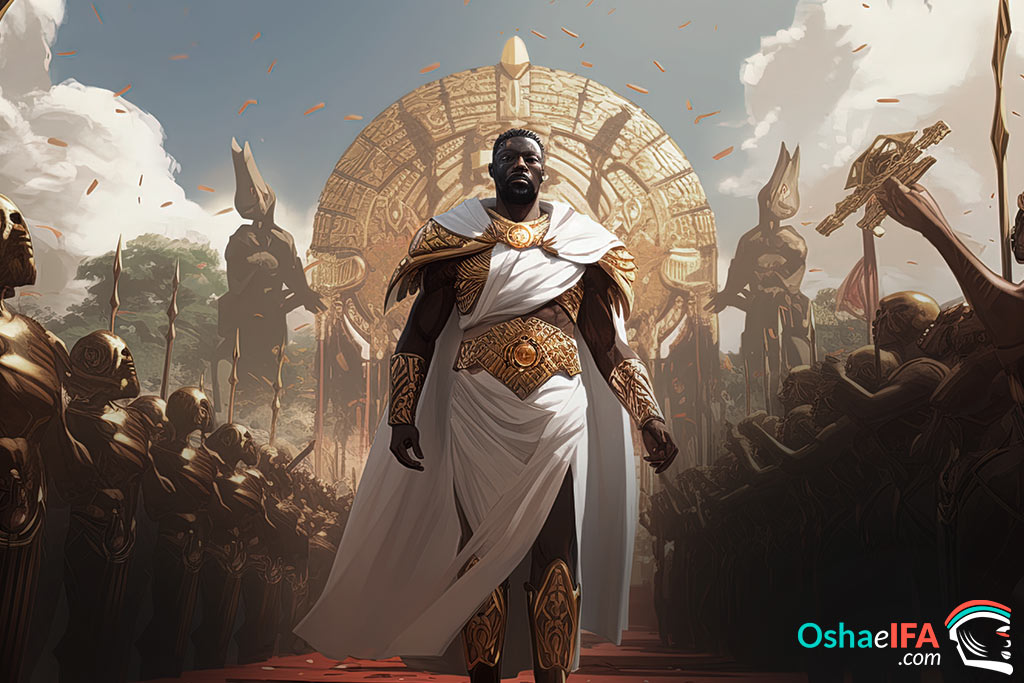
They say that Oduduwa being a skilled warrior, he fought alongside Obatalá, who at that time was the leader of the Igbo people, belonging to Ilé-Ifé. After that, Oduduwa is credited with encouraging the creation of a Constitution to lead Ilé-Ifé, making him its main leader.
Obatala He immediately disagreed, since he considered that he had the same amount of merits to hold that position. Their dispute led to a strong battle, resulting in Obatalá defeated by Oduduwa.
Nigerian history manifests that before the arrival of Oduduwa there were 13 clans belonging to the peoples that made up Ilé-Ifé. Each group had an Oba (king). Oduduwa belonged to the town located on the peaks of Oke Ora. From there he fought and beat Obatala.
Legend has it that Moremi, who was the wife of Oduduwa, at the beginning of the fight went to the river one day and gave his word to the gods that if they managed to discover the secret with which Obatala won the wars, in his honor he would sacrifice his only firstborn known as Oluorogbo.
After that, Moremi was captured by the Igbo, but when she was taken to her place of seclusion, she discovered the secret that helped them in the confrontations. It was a practice carried out by warriors in which they covered their bodies with leaves of vegetation pretending to be spirits. Oduduwa's followers, observing walking plants, fled.
Due to the great beauty of Moremi she manages to seduce the king of the Igbo, and by enjoying his trust she can escape. Upon arriving where Oduduwa transmits everything discovered. Having to fulfill his promise by sacrificing his own son in the river named Ezimirin.
Finally, Oduduwa was a hero in the history of the Yoruba people. However, after his victory and beyond his death, his followers and those of Obatala made a pact in which Oduduwa had full political authority, but Obatala and his people obtained religious authority.
You can read: Who is Orunmila?
What are the children of Oduduwa like?

The male children of Oduduwa are physically tall and thin, in some exceptions we find more robust ones. His daughters physically have a mysterious beauty that makes them very seductive. Usually your children in their childhood can turn out to be sickly and weak. People ruled by Oduduwa tend to enjoy very long lives. They are very attached to responsibilities, and great seers or mystics. When they are badly aspected they can become selfish, manipulative and transgressive, characteristics that are not at all appreciated by the Orisha.
What are the sons of Oduduwa crowned in Santeria?
This Orisha is not crowned directly. Their children are usually consecrated in Obatala. Also their children can be consecrated in Oshun or Shango in some cases. The most advisable thing is that the Orisha to be consecrated is determined by Oduduwa himself through his Ita at the moment in which his son receives his foundation. Men are usually consecrated in Ifa after receiving it, if they do not have any impediment to become Awoses.
How is Odùdúwà cared for?
The most common adimuses offered to Odudúa They are: 16 breads, glasses of milk, cocoa butter, husk and kolá. Glasses of fresh water, 16 white candles, almonds, yams, grated coconut (only the white part), fish and smoked jutía, corn, rositas or popcorn. Fresh fruits.
The animals that are sacrificed to him are: white goat, chickens, quail, guinea.
Herbs of Odua
- Cotton.
- Tree of the bibijagua or white bell.
- Horn tree.
- Tree of Life.
- Lily.
- Ceiba or Iroko.
- Marble flower.
- Galán by day.
- Ivy.
- Plantain or yanten.
- Prodigious or everlasting.
- Sage.
Odudúa in the Catholic religion (syncretism)
In the Santeria or Rule of Osha Odudúa it is syncretized with Jesus Christ, either in images of the "Most Holy Name of Jesus" or the "Most Holy Sacrament." Its syncretism, at least in the case of the Blessed Sacrament, is evidenced due to the high esteem with which the devotees keep its custody through the monstrance or ostensorium, which can be equated with the chest that guards the foundation of Oduduwa. A kind of sacred receptacle in which a high energy is protected that holds a great hierarchy that also represents the leadership of a religious people and enjoys great devotion from the devotees in both cases. The reason why the Yorubas brought to Cuban land syncretized both spiritualities is then obvious.
What is receiving Oduduwa?
Receiving Oduduwa is a ceremony that the Balawos perform to the Iworos or Aleyos that have the foundation of this Orisha marked. Receiving this deity can be determined by the Oracle of Ifa or the dialogue through an Ita.
Benefits of receiving Oduduwa?
This is an Orisha who comes to bring stability from a spiritual point of view. His Ita is decisive for the lives of his initiates and it is recommended to follow him to the letter, since what he predicts becomes a sentence. Still, your conversation can represent the way forward to achieve success in life with confidence.
What is asked of Oddúa?
Oduduwa is an Orisha who is usually asked under the following circumstances:
- For situations in which we need to obtain health.
- To achieve spiritual peace and stability.
- To understand more clearly our destiny on earth.
- To get out of truly complex situations.
Odudúwa prayer
I praise the spirit of the other world.
I pray that your blessing always reaches me.
So that the offspring are fresh and healed are our ancestors.
So that the corn of our harvest is a reflection of our sacrifice.
So that your light turns us away from the shadows that blind our earthly eyes.
Oh! Father of the other world, with your white cloak you walked among the dead.
Deliver us from sickness and death, today and forever. Cleanliness.
Works or ebbo with Oduduwa
In Santería, there are different works or rituals that are performed with Oduduwa (Oduwa) to obtain his blessing or protection in various areas. Below, we present some of the most popular and effective ones.
To health
Two pigeon eggs are used that are spread with cocoa butter, husks, and wrapped in cotton. 4 leaves of sage are placed on top of it in a cross and 4 leaves of prodigious also in a cross. All this is covered with a white cloth or cloth. Odudúa is given knowledge of what is being done and health is implored. The person is cleaned with it for 16 days. Then it is taken to the foot of a ceiba tree.
Work with oddua to implore his help
A white cup is used where two tablespoons of white sugar, an egg white, 4 tablespoons of water are placed. It is covered with cotton and 10 drops of perfume are added, 2 white candles are lit. Odudúa is told why this work is being done.
Oddúa phrase
Oddua says: "What is written cannot be erased, so what has to be will be."



Hello, I am the son of Obdduwa, my guardian angel, health and prosperity.
What is written cannot be erased, so what has to be will be.
Yemaya's children can take Oduduwa