
Okana Meyi or Okanran Meji: Meaning, Tips, Sayings, Traditional and more

Okana Meyi or Okanran Meji is an Odu of pride and disenchantment, he speaks of bad gratitude, people who have this sign are generally haughty, they believe they have everything, they are rogues and businessmen, but they lose by their bad head, they should not ingest alcoholic beverages and if it is white much less.
The Odu Okana Meji is of forces and traps, they do not allow anyone to send them, they think they know everything, they do not listen to advice, nothing is impossible, they have a fiery temperament, they do not quench their thirst, until they see what they want, and give Even life in order to destroy those who have done something even simple and do not remain calm, proud, they want what they understand to be done in a way and form, they only believe in themselves and that is why they withdraw their protection.
Pride loses them, they believe they are great and powerful, but they do unworthy things, difficult to forgive, they argue and insist, they are always unhappy. Okana Meyi is an Odu of curse and war between religious family and blood, they resort to weapons and iron when they are uncomfortable.
What is born in the odu of Ifa Okana Meyi?
- Born: Outside the wheel, its detachment.
- Let Eshu-Elegba eat rooster for the first time.
- The virtue of the monkey.
- Eshu Aluasama. That turns people upside down.
- Porous stones to filter water.
- The delivery of Awofakan and the delivery of the Ikofafun Osha Nile.
- The black vampire.
- That the rooster is the king of women.
- The cricket. (low to the world).
- Deliver the left leg of the animal that the Awó kills in the sacrifices. (the free hand you were given to prosper.
- The dogs, the coyotes and the wolves.
- Gallbladder.
- The human word on earth. (Oshalufón put his tongue to the fetus)
- Triplets.
- Let the ants come down from Heaven to Earth.
- La Palma Real. (The only safe tree against the attack of strong winds).
- The wound healing process.
- The houses in the village.
- Nomadic peoples.
What is the Okana Meyi sign talking about?
- Afeke. (The defense of Shango prepared by Orúnmila.
- The rope. (chained things).
- It was in the Odu Okana Meyi that Shango came down to Earth. (That's why it's his Odu Isalaye).
- Osun represented by the rooster, was Olofin's henchman.
- Ogún paid double the Ifá.
- Oyá could not give birth.
- Eshu Okana Meji, was the one who accompanied this Odu and Shango to Earth
- Okana Meji is the head of the Ibejis and their mysteries and secrets are born.
- Here: The Awó kills his white horse in the swamp.
- Eshu transforms into a dog.
- They speak the colors red, black, white and blue.
- Three people die suddenly.
- The men did not recognize Orúnmila for the good he did them. In the same way they will do to the Awó.
- The men learned to cook with fuel (minerals). Do not cook with charcoal.
- Conscious Eshu to the Babalawos, faults are forgiven.
- Ifá indicates who are Priests.
- En Awafakan (Orula's Hand) the person has to go to Ifá urgently to get rid of death.
- Eshu grants the opposite that you ask.
- You cannot have cats.
- Can not reveal secrets, to preserve life.
The Okana Meji sign points out:
- The antimony stone is said to be the eyes of Shango.
- Awoses tend not to make things whole.
- Okana Meyi herbs are: Plantain, sesame, taro, Iroko, Ceiba, yagua, marjoram, alacrancillo, lemon verbena.
- The diseases are: Physical deformity, contagious diseases, addictions to drugs or narcotics, shortness of breath, ailment in the spine, deafness, stomach ailment, kidney problems, high blood pressure, stroke, ailments in the belly with possible surgical intervention , leg problems, sexual impotence, pain in the arms.
- Olofin came to earth.
You may also like: Shango, history and characteristics of this Orisha.
Recommendations of the Okana Meji sign:
Here the man is very womanizer and the woman likes men very much. Ants should not be killed, as they will live in your home as proof of their development.
Things must be asked of the Deities in reverse. You must take good care of Eshu, as he punishes the Ifá Priests for being disobedient. What you see do not communicate it, so as not to lose grace. Money should not be spent for fun. Keep your nails long. A trip will bring you fortune. The harm turns into good, and the harm they do to him serves him good. A chick must be raised until it is a lucky rooster.
The Oddun of Ifa Okana Meyi clarifies that Shango is the spokesman who summons the Divine Council and the "Great witness" in the consecrations of Ifism.
When performing ceremonies to Egun, sacrifice or offend something to Shango.
In this Odu, the woman imposes herself, she is a fortune teller, but allows religious rules to be violated and the man does not occupy his rightful place.
You have to take care of the candle and it can cause deformations in the body, and that this leads it to be the mockery of everyone. All for not hearing advice.
Here by your effort and intelligence you get what you want. Here the person must try to receive his own Ifá.
The children of this Odu must put to Idefá, some accounts of Oyá. As they should not disagree or argue.
Okana Meyi talks about property theft. You have to watch out for reptiles. Your enemy is the rain. Don't do favors.
Sayings of the Odu of Ifa Okana Meyi:
- He who eats cooked food does not care about the farmer who produced it.
- Water cannot be tied with a rope.
- The fishing tackle does not catch a hippopotamus.
- The water with which one washes one's hands, after it falls to the ground, cannot be collected.
- The heat battle never conquers the cockroach, and the cockroach never enters the soup.
- Five fingertips never collide with each other.
- The dog from nosing around has a wet muzzle.
- The mouth that I feed I will never give my sentence.
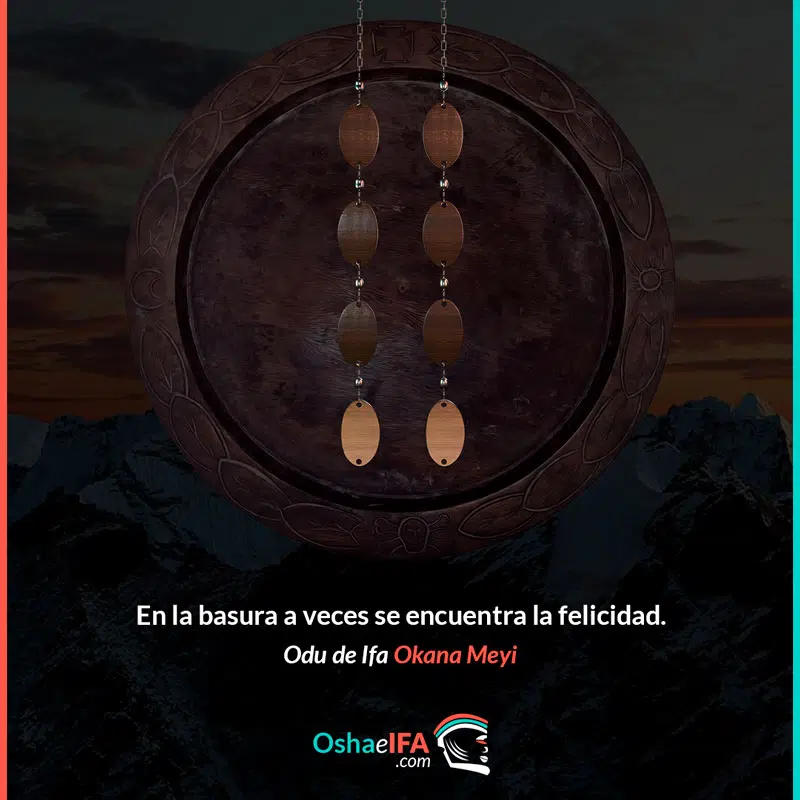
- Happiness is sometimes found in the trash.
- The head of a man has two opposites: the anger of the heart and the desire for love.
- Nothing will fall from a well tied bag if it is turned.
- The farmer's way.
- There is good and bad in the world.
- Criticize everything that surrounds you, try to look outside.
- A downed tree will fall under your trunk door.
- The forest has a good grass and a bad one.
- If two pieces of iron are welded, they cannot be separated later.
Says Ifa Okana Meyi:
When this Odu comes out in the Ikin divination, the diviner should be asked if there is a deceased member in the family who has not yet been granted a final burial. He should also be asked if there is a woman in the family who has no children, if the man has a wife without children, he should be told that the woman will surely leave him because the marriage was not authorized by her Guardian Angel.
When Okana Meyi goes out in divination, the fortune teller must be told that he has a tall and strong enemy who goes in search of his downfall. To overcome the problems created by it, he must be told that he must sacrifice Eshu with a goat, a rooster, an ax, and a machete.
When this Oddun of Ifa comes out in divination, if it is Iré, normally she will be told that her mother has just made sacrifice for him or her. And if this Odu has been manifested by Osobo, the person should be advised; tell the mother to make sacrifice for him or her against imminent danger of death.
Ifa says in divination for a person who was planning for a new position, he should be told that success is awaiting him, but that death stands between him and the achievement of success. Therefore he must make a sacrifice to The Witches and Eshu in order to remove the danger of death from his path. So that you are never short of material things and especially food, you must sacrifice two pigeons, two rats and two fish to Eshu.
If the person is going to travel, they must sacrifice a goat to Eshu and two dogs, a pig to Ifá, a club, sixteen packages of cold corn bread and beans, to avoid losing their lives when they enter a forest.
When the Odu Okana Meyi appears in Igbodun, the initiate must be advised that to obtain a long life he must sacrifice a goat to Eshu, pray for his head with a rooster and kola nuts; Give Ogún a rooster, a turtle, a gourd of wine and a roasted sweet potato; To Shango a rooster, bitter kolá nuts and wine, as they can be the victim of a storm, thunder or lightning.
Okana Meyi in the Oracle of Ifa predicts that the person must become fond of farming, as he will be successful in agriculture, he will be a landowner or a farmer, for which he must offer in sacrifice a white robe with many pockets filled with kolá nuts, cleaning himself with a chicken and using a staff, collecting materials from the top of two hills close to each other, as well as from two eaves on the roof of his house, all these materials will be used to summon Eshu.
For the person to receive an important title or position, he must sacrifice a goat to Eshu, a goat to Ifá, a rabbit to the Witches and a rooster to honor his head.
Prayer of the Odu Baba Okana Meyi:
OKANA MEJI ONI KANA NI OKUTE OKANA MEJI NI ESHU BI EBO ADA ESHU BI
ADIE PAKIKO ADIE ONADERE OKANA MEJI. OKANAIRE IFA, OKANA IRE AWO, OKANA
I WILL IRE SHANGÓ, OKANA I WILL IRE ESHUBI OKAN NI OKANA UMBATI OSODE BAYALOKUN
ONE.
Suyère Oddun Okana Meji:
ESHUBI AWADA SHUREO, ESHUBI BI AWADA SHUREO
IRO BARORO ADIE BARORA, ESHU BI AWADA SHUREO.
You may also like: Treaty of Ifa, Oddun Obara Meyi
Ebbo of the Odu Okana Meyi Ifa:
Okana Meyi's Ebbo to ward off disease:
Awó becomes Ebó to ward off the disease and must do it once a year. Take a gourd with cooked cornmeal, a branch of mariwó, two small chickens (jio jio) and eleven snails, 9 pieces of coconut, jutía and smoked fish, corojo butter, toasted corn, a large gourd.
After the Ebó the mariwó branch is cut into two parts and placed in the large gourd in front of Eshu. The two little chickens (jio jio) are given to Eshu, pouring blood from both of them on each piece of the cut stalk. Above all this, the cooked flour is placed in four portions and they are added with jutía and smoked fish, corojo butter, toasted corn, the eleven snails and the nine pieces of coconut. It is taken to a place away from home.
Work for Sorcery:
Take a taro leaf on which Okana Meji is painted and put it in a tank with water.
Afterwards, the person will wash their face and hands and will not dry it, it is allowed to evaporate. Then that leaf is put on the Ibejis and it becomes dust to blow on the door of the house.
Tips from the oddun of Ifa Okana Meji (1-1):
- Okana Meyi prohibits eating rooster, beef cooked back and forth, black and red beans.
- Nothing is tied.
- Note: For the beef it was made rich, and with the beans it was made ekru, olele, ekru-aro, so that Eshu would eat in the form of a dog, because the boa was going to eat it. For this Ifá you should not cook with charcoal, because here humans learned to cook with mineral fuel.
- This Odu assures the Awó of invulnerability against witchcraft. This is achieved with a taro leaf, on which the Okana Meyi Odu is painted and poured into a tank with water, to wash the face and hands and do not dry, it is allowed to evaporate. Then that leaf is put on the Ibejis and it becomes dust, it will be blown on the door of the house.
- Here the faults are forgiven. Eshu conscious to the Awoses. This Odu works at night.
- The Orishas that speak in this Odu are: ESHU, DIGNATARIES OF THE NIGHT, EGUN, OLODUMARE, SHANGÓ, OYA, ODUDUWA, OBATALA YEKU YEKU, OSHUN, OSUN, ORUN, AZAJUANO, YEWA, OSANYIN, OBA, THE IBEJIS.
- It is where Ifá indicates: Who are its Priests. You have to work Ifá. When this sign appears in Awafakan (Hand of Orula), the person must do Ifá as soon as possible, if there is no greater cause that prevents it, because it is the only thing that saves him from death. Must do Santo before.
- Okana Meyi is a transitional Oddun. This Ifá prescribes that everything that the person possesses must be very clear, because it is very easy to become Osobo. Here what is known is not asked.
- You must analyze the behavior of the Gorilla, the Boa Constrictor, the coyotes, wolves, gallbladder, the cat, the rope, chain, the lightning bolt and the tongue.
- This is where the dead cheat the living. The woman can have an abortion, she wants to have children. What Eshu asks is given to Shango and vice versa. People say they are liars. Justice enters through a love triangle.
- Here a chain the size of the Awó is placed inside Olokun. You have to pay tribute to their ancestors.
Meaning of the Sign of Ifa Okana Meyi
Okana Meyi means court troubles, suffering, and evil vibes.
The children of this Odu beat their heads with their nails to say the right thing. People sometimes think that the children of this Ifá are aggressive and dominant, because they try to make contempt prevail at all costs. In most situations they rebel against the conventions of society and create problems for themselves.
Barn, farm and agriculture sign.
People with this sign of Ifa are prone to infections, so they must take care of their health, so as not to get chronically ill. The person must make a commitment to mitigate the problems.
When the Oddun left, the Ifá priest pulled his left ear, because he was deaf because he did not hear Orúnmila's advice.
Ifa Okana Meyi Oddun Treaty
When this Odu (Okana Meji) appears in Ikofafun, the person has to do Santo and then Ifá, since the latter will save him from death.
This Oddun of Ifá is female, daughter of Sedikorú and Ajantakú. Day of the week: Oyé Y Shegun (The day of victory) -Tuesday-. Ruling planet: Irawologun.
Metal: iron. The grass: The plantain.
Announces sudden death of three people. Represents: The rope, praying, diseases, Chained things. Contagious diseases were born. Porous stones to filter water. Gallbladder. The wound healing process. the word in humans. The virtue of the monkey. Eshu Eluasama. The Awafakan and the delivery of the Ikofafun. The black vampire. Let the rooster be the king of women. The cricket, and went down to the world, Deliver the left leg of the animal that the Awó kills in sacrifices. The dogs, the coyotes and the wolves. The ants and they came down to the ground.
This is where: Eshu turns into a dog. Where Oshalufón, put the tongue to the human fetus.
The colors speak: yellow, white, black and red. Triplets were born for the first time on earth.
Here the Ibejis speak. It symbolizes or their secrets are born.
Because of this Odu the person cannot get wet with rainwater. And when you go out to the street, never say where you are going, offer the information backwards.
This was where Olofin came down to Earth.
In the Oddun of Ifa Okana Meyi is responsible for the excess of words. Water cannot be tied with a rope.
Here the men did not recognize Orúnmila for the good he did them. In the same way they will do to the Awó.
Odu Okana Meji Ifa Code of Ethics:
Elewá always pampers the Babalawo.
Pataki of the sign of Ifa Okana Meyi:
Ogún paid double his Ifá.
One day Eshu went to Orúnmila's house to do him a favor of doing Ifa, and Orúnmila asked him if he had the money to do it, Eshu answered him no. Then Orúnmila replied that if he had no money he could not do Ifá, then Eshu jumped and reached the ceiling, breaking his head and for this reason shed a lot of blood. Then Orúnmila's wife, seeing this, told him: "Now justice has to come and they are going to arrest us."
Orúnmila, seeing his wife so scared, called Eshu and made him Ifá. When he had finished doing it, he said, "You can go now." Eshu left and stood on the corner and then Ogún came and he told him to greet him, because he had done Ifá. Ogun told him: "Well, if you have done Ifá, register me."
Eshu registered him and said: "In your house there are many chickens and these at night they perch." Ogun replied: You are a liar, because you knew that. Eshu said to him: Well, all right, wait; This morning your mom scolded you because you touched her from behind and her husband saw her. Then Ogun said to him: That is true, because you weren't there. Ogun left.
When Ogun got home, he told his mother what Eshu had told him, and he said, "I want to be Babalawo." The mother replied: Ask Eshu how much it costs to do Ifá.
When Ogún asked Eshu how much it cost to become Ifá, he replied that it was a cart of money. When Ogún left, Eshu went to Orúnmila's house and told him that Ogún would come to do Ifa for him, that he had asked him how much it cost him and he had told him that a cart of money, and that is how Ogún paid double his Ifá.
Okana Meji Ifa Traditional Nigerian
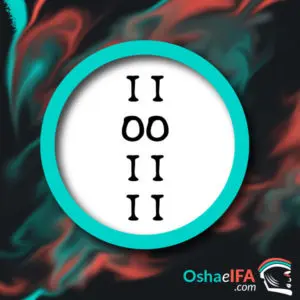
ÒKÀRÀN MÉJÌ
Òkànràn kan nihìín
Òkànràn kan lóhùún
Òkànràn di Méjì or se ìdí jàwàlá
A day fún Jìngbìnní
Èyí tí n lo rèé fowo araa rèé kiss
Owó òun will I go to you?
Wón ní kó rbo
Ó yes gbébo nbè
Ó rubo
Owóo rè tú tutù
Owóo rè to ajé
Òkànràn kan nihìín
Òkànràn kan lóhùún
Òkànràn di Méjì or se ìdí jàwàlá
A day fún Jìngbìnní
Èyí tí n lo rèé fowo araa rèé kiss
Jìngbìnní mòmò dé or awoo re
Owó mi to tutù jé ó I got off
Jìngbìnní dé ò awoo re
Owó tú tutù jé or lowered.
Ifá says that this person will obtain all the fortunes that he had been following. But they advise you to make sacrifice. He must not reduce the elements of his sacrifice.
It means:
An Òkànràn is located here
Another Òkànràn is located there
Òkànràn became two, having its base inclined
They made divination for Jìngbìnní
The one who would reap the fortunes with his hands
She asked 'Will my hands get the fortunes?'
They advised him to sacrifice
She heard about the sacrifice
And he did it
The hand that had not been full of riches
She got immensely rich
She said that a Òkànràn is located here
Another Òkànràn is located there
Òkànràn became two, having its base inclined
They made divination for Jìngbìnní
The one who would reap the fortunes with his hands
Jìngbìnní is really a good priest here
Let my hands be cool to touch fortunes
Jìngbìnní is really a good priest here
Let my hands be cool to touch fortunes.
Learn everything about each of the Mejis:



It took a short time from IFA AND I NEED TO LEARN
Iboru iBoya blessings, thank you, I have learned a lot
I really liked the breakdown and way of explaining it. Ash