
7 Rays: The fire deity of Palo Mayombe

This deity is also known as Nsambi Munalembe, although many claim that his true and only name is 7 Rays. He represents all the imperfections and virtues of man among these masculine virility and beauty.
Who is 7 spokes?
7 Rays is considered one of the main Mpungos within the Mayombe stick, is a highly masculine deity, volatile and aggressively protective of his children and devotees. He is the king of fire, a weapon with which he attacks his enemies, who end up being victims of sudden and casual fire. This deity is unshakable towards his children and turns them into elusive beings in the face of the most effective works of witchcraft and damage that they do to attack them. Under no circumstances does he allow anything negative to happen to his children.
Around this Mpungo there is a lot of syncretism with the rule of Osha and Spiritism, where it is directly related to the Orisha Shango and with Santa Barbara respectively, it is also related to Gods of Hittite, Greek and Roman mythologies.
History of Seven Rays
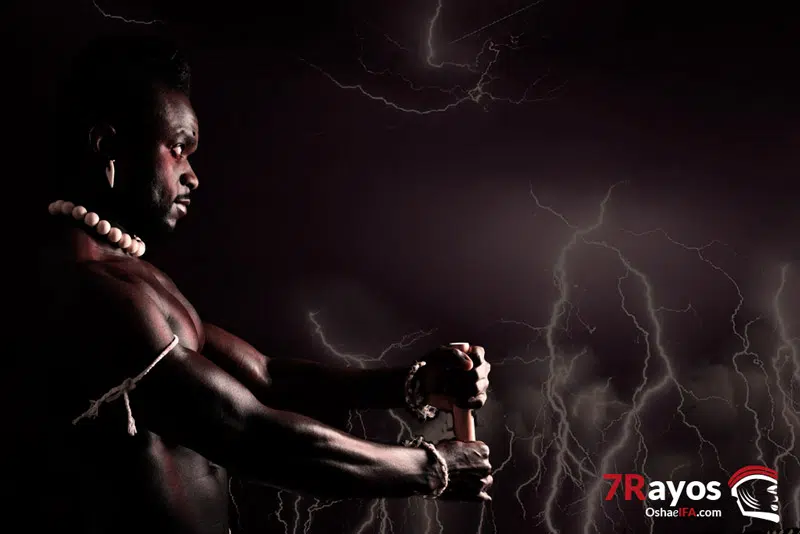
In the legends and stories of Seven Rays within the Palo Mayombe cult, it is said that this deity was a King from South Africa, specifically from a City called Cetewayu that lived at the end of the 7th century, he was known by the name of Centewayo or XNUMX Ray name very similar to hometown. Its great powers and attributes obey the belief of those who inhabited the town and claimed that it was the exact symbolization of a Lightning, since then it has been considered the God of thunder.
Many people besides Rey consider him a great sorcerer and one of the most dangerous and fearsome warriors within the Palo Mayombe cult. Despite having a difficult, aggressive and volatile character, it is an excellent guardian of love relationships between humans.
Next, we present one of the many stories that revolve around the great Seven Rays.
History of 7 Rays: El Toro de la Loma Ngombe
A long time ago there was an African bull named Ngombe who his father punished a lot since he constantly harassed his brothers by fighting with them and instilling bad habits in him, the punishment imposed by his father was to stay away from the herd to avoid hatred between the family.
Since then the bull was seen marching behind the herd, when they stopped to bathe or graze Ngombe (Seven Rays) would go away and go up to any nearby hill, his mother suffered a lot when she saw her son sad and bored since his brothers they ignored and mocked him.
After a while the father of the pack decided to name a successor since the years had weakened him, so he told his children whoever manages to knock down this tree will be the new king of the pack, all the youngsters out of nowhere tried to knock down the ceiba but none of them succeeded; The queen mother asked the king to allow him to climb the hill where Ngombe was so that he could try to knock down the tree, the king looked towards the hill and saw that 7 Rayos was very sad and thought it was impossible for him to bring down the ceiba for therefore I accept the request of the queen mother, even thinking that her son Ngombe would not succeed.
The mother climbed the hill and standing next to her son, emitted a long bellow towards the sky and to the amazement of all, they saw how Seven Rays grew and took on a reddish color at the same time that his head flashed a luminous aureole, the Which blinded the others, as the bull crossed the distance that separated him from the ceiba tree and with a single collision he knocked it down, to the admiration and shame of all his brothers. Then by decision and mandate of the King he was proclaimed king of the pack and demonstrated the power that he had obtained from on high.
This little story is attributed to the 7 Ray deity in his manifestation as Ngombe. Hence the legend that this can not be given an offering in La Ceiba, but in a palm since La Ceiba does not receive a visit from this deity because of what happened.
Characteristics of the children of 7 rays
The children of 7 rays are characterized by having great facility to generate wealth. In addition, they are often the center of attention during social events or feasts so they naturally stand out anywhere and are known for their gallantry and attitude to the problems that come their way.
They transmit unique energies which are so high that they transmit security and confidence around them. They like to go to parties and be the soul of them, they are excellent dancers.
On the other hand, in addition to having many positive characteristics, they have some negative ones such as aggressiveness, a facet in which they tend to get angry very easily and it is very difficult to make them calm and quiet.
It should be noted that in particular the daughters of seven rays are very spoiled and overprotected by him, since he never leaves them alone. Likewise, through his powers he does not allow tragedies or negative events to happen to him in his life, so it is not advisable to mistreat a daughter of seven rays in any way.
7-spoke paths
- 7 Ray Ensasi Sun Sun Vira Vira: This path of 7 Rays is used to eliminate at 12 o'clock at night a religious who is in the cemetery.
- Ensasi Eyebrow Mount: Used to try to control the four (4) winds.
- Kongo silage: It has two (2) uses, the first is to hold the four corners, and the second is used to feed the Lucero Pitilanga.
- Ensasi Patikongo: It is used to remove evil spirits from the home.
- Ensasi Wins War: It is used when a Drainer has problems with another drainer, it should be placed behind the door practically on the ground, and a rooster is offered to him.
- Seven rays Ensasi Disrupts and composes: This Seven Ray is used for two purposes, the first is to destroy and the second is to create a nganga at the foot of a tree.
- Dambranu Ensasi Siete Rayos Guinda Candle Samalongo Munamanza Tengue: this is done in order to offer food to Sambranú Nsasi that is placed at the foot of the trunk of the Nganga, that is, in the palm.
- Sambranu Bolombo Seven Rays Seven Loma Musindi: This 7 Rays, is the banner of the Good Journey of the Holy Christ.
- Sambranu Ensasi Munalongo: It is used to control the four (4) garbage mount winds, it only has two (2) moments, the first is in the afternoon and the second is at dawn (at six in the morning).
- Sambranu Ensani Nunga Nunga Munanfilo: This path has many uses, first: with this one it is possible to detach an enyayi nkisi, the guardian of the nganga, a father, to offer food to the 7 Rays; This can be in the bush or in the savannah and in order to control it, fourteen (14) loads of fula are used.
- Lucky Munuanco: It is done in order to be able to control the 7 thunderbolts with 7 fula charges, it is carried out in the mountains.
- Ensasi Laguna Negra Briyumba with Mayombe: It has several purposes, one is when the Nganga is asleep and does not respond.
- Corta Lima Briyumba with Mayombe: This arose from the old Corta Lima Makiribono Bacheche treaty, also when Corta Lima was offered the caiman in Sagua La Grande (this was a fisherman who was able to cut off the head of Lima, who was another fisherman).
- Sambranu Ensasi Engo La Finda Briyumba Kongo: this is used for a birth or a consecration, and also to carry out the loading of a drum for the dead, which does not have a loaded drum.
- Seven Rays Munianko Lucky: It is used in women who are menstruating at that time; It begins by placing the signature on the ground and then placing two candles to complete the consecration.
- premañongo: This path begins for the first time when 7 rays devoured a calf on the Adekaida hill, it is used to pick up a dark deceased who is in an Osain manufacture (which is highly respected and deity of Palo Mayombe); and in a house that has a convocation or prayer looking for good vibes to the identities that are being summoned.
- sambranu ensasi Have yaya: It starts when the goat rides the alligator; and also when the tribes, kongo kasimbo wanted to reach an agreement with the kongo korama, exchanging food for wisdom, but the kongo kasimbos did not want anything, so a war was started that lasted five (5) years.
- Sambranu Ensasi Munankite: It is used only in rituals, the first is used for the consecration of the mark of the 7 rays, and the second is used to make a break with the father nkisi (who is a spirit of a deceased who decided to adopt an artificial object , who has superhuman capacities) outside the home in religion.
- Bad Via Briyumba With Mayombe: This is used only when the Paleros are at war at twelve (12) at night, and should not be used at another time; To know if the war will start at a precise moment, it is necessary to ask the gando and then give him food.
- Dark Night Briyumba Kongo: This path of 7 rays is used to request a change of life.
- Seven Gate: this is quite sacred and with it the kongo office is made above the nganga.
Offerings to 7 Rays
Seven rays are offered fruits such as bananas, Red Apples, Mamey or Sandia. He likes spirits such as brandy, rum, red wine, chamba, and sangria. The foods that are placed on it must be seasoned with palm oil (corojo butter) and then when removed they must be carried at the foot of a palm.
Among the herbs that are used in their rituals are: pigtail, saucer, sarsaparilla, palm leaves, elm, jobo, banana and Chinese berry.
Seven rays eat roosters, quails, goats, goats and rams.
We must bear in mind that to seven rays never and under no circumstances should ceiba or any derivative of this be offered or offered since, in doing so, this deity will not visit or protect whoever does it. In substitution of this, the palm can be offered since this is its main stick or herb.
Prayer to Seven (7) rays
There is only one prayer for seven rays which must be done with great respect and devotion towards this Mpungo.
In the name of God.
Ancestral father of fire
Seven Rays Father of the flame,
With the fire of life, light my way.
With your ray, deliver me from all evil.
Sitting on the mountain as the absolute king,
with humility I cry your name.
To win, give me strength when I am weakest.
Give me courage when I'm scared
and grant me your scepter that is your ray to defeat evil.
7 Ray Signatures

Within the Palo Mayombe cult there are hundreds of signatures for each Mpungo, these are used to better denote the phenomena that occur around us, as well as to solve all those problems that some person may present. These firms can open and close the roads, as well as can be of great help in the resolution of conflicts of any kind.
With 7 rays you can implement different strokes to ask for their help in different situations.
Signature of Seven Rays to defeat the War
This signature is used when you have problems with a drainer which is using the different Nfumbe for evil. When this signature is used, a 7-Ray rooster is given at the door of the house.




Hello
Morning
It's very smart to know about 7 rays
I am very interested in knowing more
Good morning I like it I want to know more and learn more about 7 rays
Very interesting to know more about 7 rays
What does a Ceiba mean in the Palo mayombe and how to know whose son I am. What to offer you!
What does a Ceiba mean in the Palo mayombe and how to know whose son I am. What to offer you! that cicnifies the Ceiba tree in the palo mayombe
Hello! Thank you for such valuable information, which signatures do you recommend for 7 rays for evolution and development. Thank you
Thank you for such wonderful information, Achee, and may God bless you.